Page 6 of 18


By Myra Adams – The Hill contributor

MYRA’S COMPLETE ARCHIVE IS HERE

Reposted from The Hill March 15, 2024

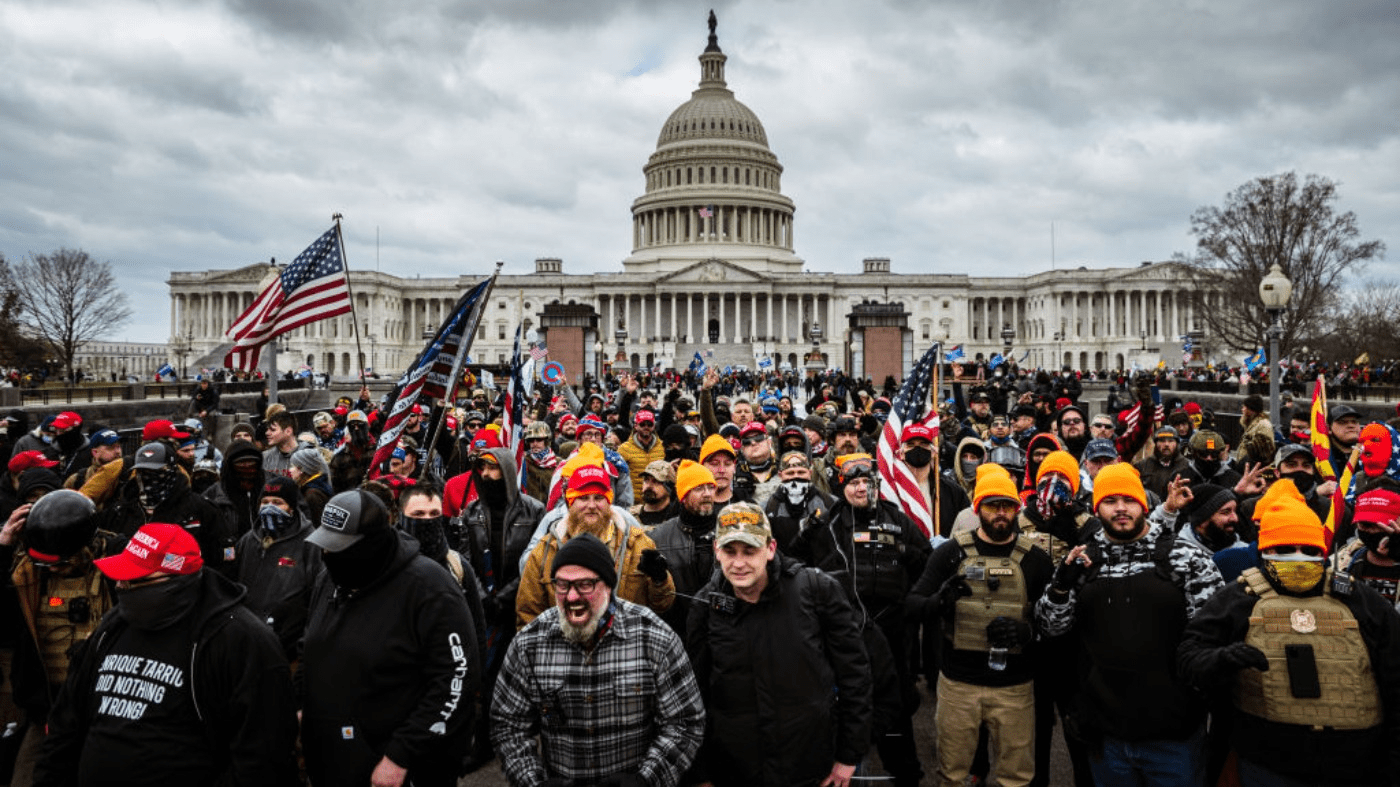
The Capitol riot of Jan. 6, 2021, presents a yes-or-no question for November’s ballot. Are you willing to forget, ignore or justify the Capitol riot that caused $2.8 million in damage and injured 140 police officers?

According to Fox News, the intruders “defecated in the hallways” and “stomped in their own feces” in their mission to keep President Trump in office by stopping the Electoral College’s certification and disrupting the peaceful transfer of power.

If you choose to rationalize such mayhem, then pray for your nation and continue to vote for Donald Trump. But if you are undecided, be aware that the former president is supported by a Christian nationalist movement that had strong ties to the Jan. 6 perpetrators — the jailed ones he calls “hostages,” whom he will free if elected.

There is no single agreed-upon definition of Christian nationalism. Some erroneously define it as the mere acknowledgment, contained in our Declaration of Independence, that all rights come from God. A more sensible definition that evinces a true threat to the republic would include the belief that America is a Christian nation whose divine destiny must be preserved, even if that entails open rebellion against lawful constitutional authority.

This belief flies in the face of traditional Christian teaching, going back to the words of Jesus and Saint Paul’s epistles, requiring obedience to just laws — including, for example, tax laws, election laws and laws against pillaging public buildings.

Christian nationalism is also antithetical to our founding documents. The First Amendment’s Establishment Clause not only protects religion from state interference, but also protects individual Americans from state enforcement of religious orthodoxy. Christian nationalists, in contrast to our nation’s founders, would condone the latter.

Since 2021, and primarily among Trump’s white evangelical supporters, Christian Nationalism has experienced mainstream growth and acceptability as a viable political movement embedded within the Republican Party. According to the Public Religion Research Institute, only 10 percent of Americans consider themselves Christian nationalists, but another 20 percent sympathize with the idea.

It is common to hear Trump’s most ardent supporters claim that “he’s anointed by God.” And Trump, although his own religiosity is dubious, has hardly discouraged the idea that he is God’s special creation, even circulating his own Trumpian version of Paul Harvey’s homage to farmers.

His supporters’ religious fervor puts real teeth into the presumptive nominee’s dark, authoritarian and apocalyptic campaign of revenge against those who, he insists, stole the 2020 election from him. And this, in turn, points back to Jan. 6, when Trump tried to overturn its result.

Among the testimony presented to the House committee that investigated the Jan. 6 attack, the Freedom from Religion Foundation’s Andrew Seidel described the overt and even ostentatious religiosity of at least some of the attackers. To be sure, one must consider the source — a group hostile toward religious belief. But what Seidel describes can be seen on video by anyone.

“The attackers were not shy about declaring their motivations,” Seidel said in his written testimony. “They held Bibles aloft, prayed in the Senate, carried Christian flags, and openly confessed to their motivations on video. The many disparate identities and ideologies visible during the attack were united under a banner of Christian nationalism, which created the permission structure necessary for Americans to attack their own government.”

Did Trump help create that “permission structure” to rebel against the United States? And would he do it again? All signs point to yes — especially his new litmus test for a vice presidential pick, to choose only someone who would not have done what Mike Pence did on Jan. 6 in fulfilling his constitutional and legal duty to certify Joe Biden’s victory.

Trump has never been known as a Christian, but he knows how to harness the fervor of the victorious warriors who waved Bibles from atop the Senate dais on Jan. 6, shouting, “Jesus Christ, we invoke your name!” He casts the current election in dark, apocalyptic terms as a quasi-spiritual battle in speeches like the one he gave March 4 in Richmond, calling 2024 “our final battle.”

“With you at my side,” Trump said, “we will demolish the deep state. We will expel the warmongers from our government. We will drive out the globalists, we will cast out the communists, Marxists, and fascists, and we will throw off the sick political class that hates our country. We will rout the fake news media, we will drain the swamp, and we will liberate our country from these tyrants and villains once and for all.”

It should come as no surprise that this speech closely echoed the prayer offered inside the Senate chamber on Jan. 6 by the so-called Q-Anon Shaman, the infamous face-painted man wearing Viking horns during the riot: “Thank you for allowing us to get rid of the communists, the globalists, and the traitors within our government. We love you, and we thank you. In Christ’s holy name, we pray. Amen.”

At the National Religious Broadcasters Convention in Nashville, Trump framed the election not as a choice between two parties or two leaders, but as a battle between good (that is himself, of course) and wickedness.

“Remember,” he said, “every communist regime throughout history has tried to stamp out the churches, just like every fascist regime has tried to co-opt them and control them, and, in America, the radical left is trying to do both. They want to tear down crosses where they can and cover them up with social justice flags, but no one will be touching the cross of Christ under the Trump administration, I swear to you.”

America saw what happened on Jan. 6, 2021. Do we really want to go back there again?

My national and Christian prayer for Nov. 5 is, “God help us.”

Myra Adams writes about politics and religion. She served on the creative team of two GOP presidential campaigns, in 2004 and 2008.

TAGS 2024 PRESIDENTIAL ELECTION CHRISTIAN NATIONALISM DONALD TRUMP JESUS CHRIST


By Myra Adams – The Hill contributor

MYRA’S COMPLETE ARCHIVE IS HERE

Reposted from The Hill – March 1, 2024

A historic milestone will be reached in the 2024 election, likely to generate political power surges across the electoral landscape.

Demographic data and current trends analyzed by the Pew Research Center found that Latinos or Hispanics are “projected to account for 14.7 percent of all eligible voters in November 2024, a new high.” For the first time, Hispanic voters are expected to surpass Black voters as a percentage of the electorate, after each group comprised 13 percent of voters in the 2020 presidential election.

Exit polling results preserved by the Roper Center show how, over two decades, the Hispanic vote grew to equal the Black share of the electorate. In 2000, Hispanics accounted for 7 percent of voters, with Blacks at 10 percent. In Barack Obama’s 2008 election, the share of Black voters grew to 13 percent, whereas Hispanics expanded to 9 percent.

The 2016 Trump-versus-Clinton matchup saw Hispanics grow to 11 percent while Blacks dipped to 12 percent. Finally, in the 2020 election, Black and Hispanic voters tied at 13 percent each.

With the Black vote stagnating at about 13 percent since 2008, the growing Hispanic vote is now expected to meet and exceed it, becoming the nation’s second-largest voter group.

Shifting from voter percentages to numbers, in January 2024, Pew Research estimated that 36.2 million Hispanics are eligible to vote in 2024, up from 32.3 million in 2020. Astoundingly, those numbers represent 50 percent of the total growth of all eligible voters.

With such exponential growth, Hispanic voters take center stage in 2024. All eyes are on the fierce battleground state of Arizona, where they will account for nearly one in five voters. According to a recent Emerson College/The Hill pollDonald Trump leads President Biden in Arizona 46 to 43 percent in a tough fight for the state’s 11 electoral votes, when in 2020, Biden eked out a surprise win by only 0.3 percent of just over 3.3 million votes.

Although Arizona ranks fifth among states with the largest Hispanic population — behind California, Texas, Florida, and New York — it is the only one where the outcome of the 2024 presidential election seems uncertain.

From a perspective well beyond the 2024 election, Hispanics are beginning to mirror emerging voter groups that changed American political history starting in the 20th century. The gender and racial composition of today’s elected leaders reflect the success of those movements.

Women were the first significant voter group to emerge after being granted the right to vote in all 50 states upon ratification of the 19th Constitutional Amendment in 1920. Fast forward 100 years to the 2020 presidential election, and women as a percentage of the electorate surpassed men (52 to 48 percent), as they have in every presidential election since 1984.

Black Americans were the second major voter group to emerge, facilitated by two legislative acts. First, the 24th Amendment, outlawing poll taxes, was ratified in 1964. The Voting Rights Act of 1965 soon followed. Both laws endeared the Democratic Party to Black voters, to which they have remained steadfastly loyal ever since.

The exit polling data show the astronomically high percentage of Black American support for Democratic presidential candidates, ranging from a low of 83 percent for Jimmy Carter in 1976 to a high of 95 percent for Barack Obama in 2008. It averages around 86 percent. Joe Biden won 87 percent of the Black vote in 2020, slightly lower than the 89 percent that Hillary Clinton had earned in 2016.

Donald Trump’s support from Black voters was 12 percent in 2020, a 4-point increase from 8 percent in 2016. Trump’s ability to win Black votes in battleground states will be something to watch for this year. Currently, Black voter support for Biden appears to be flagging and, potentially diminishing his chances of winning battleground states such as Georgia, North Carolina, Michigan and Pennsylvania.

Although Black Americans have historically voted as a block, Hispanic loyalty to Democrats is far less certain. On average, they vote about 66 percent Democrat. In 2020, Trump improved his percentage with Hispanic voters, taking 32 percent, up from 28 percent in 2016.

The latest census data show Hispanics making up 19.1 percent of the population, compared to Blacks at 12.6 percent and non-Hispanic whites at 58.9 percent. Those percentages portend the dramatic national power balance shift now underway between Blacks and Hispanics, further complicated by the shrinking non-Hispanic white population. 

To the extent that a cohesive “Hispanic vote” exists, the 1 million young Hispanics turning 18 every year represents a steady stream of demographic voting power. Thus, a front-burner question for political strategists is how many of these young Hispanics plan to register and turn out to vote.

The second question is whether they will still vote 66 percent Democratic as in decades past, giving Democratic presidential candidates the margins on which they have depended. Alternatively, are they headed in the same direction as other formerly Democratic Catholic ethnic groups, who shifted dramatically toward Republicans in the late 20th century, leading to today’s evenly-split Catholic vote?

That’s for Republicans and Democrats to fight over this year, and well beyond the 2024 election.

Myra Adams writes about politics and religion. She served on the creative team of two GOP presidential campaigns, in 2004 and 2008.TAGS 2022 MIDTERMS 2024 PRESIDENTIAL ELECTION DONALD TRUMP DONALD TRUMP JOE BIDEN PRESIDENT JOE BIDEN


By Myra Adams – The Hill contributor

MYRA’S COMPLETE ARCHIVE IS HERE

Reposted from The Hill Feb. 16, 2024

For the third time in a row, former President Donald Trump is expected to win the Republican nomination. His chances of becoming the 47th president are no worse than 50-50. Not only is President Biden a weak incumbent, but Trump appears to have the momentum and the lead in most of the key swing states.

Never in our nation’s history has a former president been at war with America. But, propelled by political winds, Trump has made himself a warrior-candidate, uniquely accepted by half of voters in a nation at civil war-levels of polarization, coupled with a general distrust of government amidst signs of decline.

On the primary campaign trail, Trump foments rage among his followers. In his Jan. 22 New Hampshire primary victory speech, he shouted his time-tested pronouncement: “This country has gone to hell, this country has gone to hell.”

War is hell, and Trump’s fans believe that only he has the blood and guts, energy, strength, and policies to save America.

Trump’s aggressive negativity is a sharp contrast with the traditional norms of campaign communication, a vast deviation from Ronald Reagan’s sunny optimism. His “Morning in America” television commercial amid his 1984 landslide reelection, clashes sharply with another quintessential Trumpian quote: “We’re going to bring our country back. With your vote, you’re going to put crooked Joe and his protectors on notice that we are coming in November. We’re coming to take over the beautiful, beautiful White House, and we’re going to run the country the way it’s supposed to be run, not the way it’s been.”

Not only does “General” Trump promise “to bring our country back” (from hell, one presumes), but he plans to “take over” the White House. No American presidential candidate has ever promised a “takeover” with a Trump-loyal army-in-waiting named Project 2025.

Also present on Trump’s New Hampshire victory stage was Vivek Ramaswamy, basking in the afterglow of his failed campaign. The former primary candidate has quickly morphed into Trump’s considerably more articulate sidekick. Ramaswamy encapsulated the 45th president’s 2024 “at-war” theme. “We are in the middle of a war in this country,” he said. “It’s not between black and white or even between most Democrats and Republicans. It is between those of us who love this country and a fringe minority who hates the United States of America and what we stand for, between the permanent state and the everyday citizen.”

Here’s an opposing view: “We are in the middle of a war in this country,” that Trump is waging against any person, celebrity, group, political party, branch of government, department, agency, institution, body of law, organization, or established process he deems to be “unfair” or standing between his goal of total domination. 

That list includes current and former Republican members of Congress, Trump administration cabinet officials, retired four-star generals, and the media, for consistently generating “fake news,” except when the coverage is favorable to him.

Trump’s lies and exaggerations are repeated so often that one-third of American ears have normalized his rantings as truth. Hence, Trump’s war will continue to thrive while his well-oiled multi-platform propaganda and fear machines are operational 24/7, to raise money and churn out promises that double as battle plans.

One controversial battle plan Trump announced during his Veteran’s Day message: to “root out the Communists, Marxists, Fascists, and Radical Left Thugs that live like vermin within the confines of our country, lie, steal, and cheat on elections, and will do anything possible, whether legally or illegally, to destroy America, and the American Dream.”

One of the most effective weapons in Trump’s strategic arsenal is the 38 percent of Americans who believe that Biden’s 2020 election was illegitimate — “stolen,” in Trump’s warring words.

Most often, Trump fires artillery about how the Jan. 6 attack on the U.S. Capitol would have turned out differently, had Vice President Mike Pence “done his job” refusing to certify the votes of the Electoral College. That explains why Rep. Elise Stefanik (R-N.Y.) and Sen. J..D Vance (R-Ohio), perhaps hoping to be named Trump’s running mate, recently stated they would have taken the action that Pence lawfully refused.

Meanwhile, planting political landmines on the campaign trail, Trump vows to rescue the Jan. 6 “hostages” with pardons. (After he finishes being dictator on day one?) Then and always, Trump uses his sympathy weapon, playing the “victim” card with his 91 felony counts, since Biden has weaponized the Justice Department against him.

Last year, the former president officially declared war, unveiling his political manifesto at the Conservative Political Action Conference (CPAC), when he said: “I am your warrior, I am your justice. And for those who have been wronged and betrayed, I am your retribution.” CPAC 2024 is next week, so listen as Trump throws fiery new verbal daggers to motivate the assembly of foot soldiers.

Another battlefront is an email blast I have somehow started to receive with a “Trump War” subject line, highlighted by a red siren mimicking the Drudge Report’s news alerts. “Trump War” points to an all-headline, Trump-friendly clone of Drudge’s famous 1990s-era vintage format — proving that imitation is the greatest form of flattery.   

“General” Trump and his army are psyched to fight and torpedo any legislation Trump fears could help Biden. This busy week, the general’s sword hangs over House Speaker Mike Johnson’s (R-La.) refusal to hold a floor vote for Ukraine and Israel military aid. Also, Trump “attacked” NATO and announced plans to conquer the Republican National Committee.

“I am really good at war,” Trump boasted in April 2016. That comes from a man who never wore the uniform but has readily ridiculed those who have. Undeniably, Trump is at war, and if victorious, anyone not in lockstep could become collateral damage. 

Myra Adams served on the creative team of two GOP presidential campaigns, in 2004 and 2008.TAGS 

2024 PRESIDENTIAL ELECTION DONALD TRUMP JOE BIDEN PRESIDENT JOE BIDEN


By Myra Adams – The Hill contributor

MYRA’S COMPLETE ARCHIVE IS HERE

Reposted from The Hill – Jan. 19, 2024

Republican presidential candidates often warn that America is declining, and that only they can stop its demise. Former President Donald Trump believes that the national decline halted during his term in office and will stop again when he is reelected.

But five unmistakable signs of American decline have been gathering momentum for decades, through both Republican and Democratic administrations. No president or party can solve these chronically intertwined, deep-rooted, systemic economic, political, societal and cultural problems. Officials can only manage the decline and mitigate the impact.

1. Uncontrollable U.S. Debt: The U.S. Debt Clock displays the inevitability of American decline — a “ticking time bomb” of data and financial evidence — especially the following three.

The U.S. government’s total unfunded liabilities — the combined amount of payments promised without funds to recipients of Social Security, Medicare, federal employee pensions, veterans’ benefits and federal debt held by the public — stand at $212 trillion, and are rapidly increasing. For context, that number was just $122 trillion as recently as 2019 and is projected by the Debt Clock to reach $288.9 trillion by 2028.

That is an unimaginable amount of money — more than a quarter of a quadrillion dollars. When or if the government is forced to reduce payments, pensions or services to hold things together, or to default on its debt, the consequences will be brutal.

The second ticking bomb is the U.S. debt. At $34 trillion, it has increased more than six-fold from $5.6 trillion in 2000. Of that $34 trillion, $731 billion has been accumulated through interest payments — the fourth-highest annual U.S. budget item. (If you are keeping score, the third-highest is $851 billion for Defense, exceeded by Social Security at $1.39 trillion and topped by Medicare-Medicaid at $1.72 trillion.)

Like an irresponsible credit card user, the federal government is perpetually borrowing more money to make the interest payments as they come due. And the interest payments on the newly refinanced debt will be much higher due to recent and significant rate-hikes.

Finally, the $34 trillion national debt, as a percentage of the nation’s $27.8 trillion economy entails a debt-to-GDP ratio of 122.30 percent, headed to 150 percent by 2028. That’s up from 56 percent in 2000 and 36 percent in 1980. Don’t expect any meaningful discussions or solutions from either party about these three “bombs” as their timers tick away.

2. Low student achievement: If our nation is to dig itself out of that harrowing debt trap, it will need successive generations of superstar students, armed with skills and creativity. Someday, they will invent and harness technologies to manufacture state-of-the-art products and related services, fueling an economic boom that boosts the GDP.

Unfortunately, the “Nation’s Report Card” does not hint at such an optimistic future. The National Assessment of Educational Progress, a congressionally mandated Education Department program that has assessed students since 1969, finds that the only 29 percent of fourth graders and 20 percent of eighth graders are even proficient in math. Only 8 percent and 7 percent, respectively, are “advanced” at those levels.

Overall achievement had decreased in both reading and math compared to the already-disappointing numbers of 2019. So both before and after COVID, our education system appears to be losing the fight against national decline.

3. Increasing income and wealth inequality: Sub-par educational achievement will probably only increase the gap between the rich and poor. Moreover, it will shrink the once-vibrant middle class — the pride of post-war America.

Pew Research, conflating the ideas of “middle class” and “middle income,” recently found this vital group to have shrunk from 61 percent of households in 1971 to just 50 percent in 2021. Although a net increase in upper-income households accounted for most of this net decline of the middle class, the latter are still bringing in a disproportionately reduced percentage of the nation’s total income — down from 62 percent in 1971 to just 42 percent in 2021.

A clearer warning sign is the decrease in homeownership, long a benchmark of middle-class status, financial stability, and wealth-building. That is another reason the gap between rich and poor could keep widening as the government spends extra billions to fight poverty, contributing further to out-of-control debt and inevitable national decline.

4. Loss of American identity and patriotism: The once-great American “melting pot” is an outdated concept for many Americans. Traditionally, immigrants with different languages and cultures assimilated and became distinctly American. The current trend is toward a heterogeneous culture.

Meanwhile, among non-white youth, adopting an American identity and even saluting the flag is considered “nationalistic,” representing an “old America” — predominately white, Christian, and inherently unequal.

Patriotism has declined, especially among more ethnically diverse 18 to 34-year-olds. That brings us to our rapidly changing population. No modern nation has ever experienced such dramatic demographic change, and already-increasing racial tensions could vastly accelerate, hastening national decline.

5. Widespread belief that our political system is broken: Americans’ disdain for the political system has been captured in numerous polls, showing voters are dissatisfied with a potential Biden-Trump rematch — “a uniquely horrible choice,” as the headline quote from one voter put it.

Team Trump is certain that only the former president can preserve democracy, save the nation from the southern border “invasion,” and stop President Biden’s “corruption,” along with the “weaponization” of his Justice Department.

Conversely, Democrats believe Biden will save democracy and the country from Trump, who will otherwise be an authoritarian ruler, shredding the Constitution.

So the political system is at least broken enough to lock in two flawed, unpopular candidates well past their prime and — along with all of the above — set America on a declining glide-path.

Let’s hope that whatever remains of American exceptionalism will triumph over and reverse the forces of decline.

Myra Adams served on the creative team of two GOP presidential campaigns, in 2004 and 2008.TAGS DONALD TRUMP NATIONAL DEBT STUDENT PERFORMANCE


By Myra Adams – The Hill contributor

MYRA’S COMPLETE ARCHIVE IS HERE

FILE – Pastor Paula White, left, and other faith leaders pray with President Donald Trump, center, during a rally for evangelical supporters at the King Jesus International Ministry church, Friday, Jan. 3, 2020, in Miami. (AP Photo/Lynne Sladky, File)

Reposted from The Hill – Jan. 5, 2024

Former President Donald Trump enters 2024 leading his Republican rivals by a national poll average of 51 percentage points. However, Iowa influencers from Trump’s loyal base of evangelical voters have established goalposts also applicable to the general electorate, should Trump top the GOP ticket.  

The first “goalpost” was reported by Reuters in mid-December. Quoted while presiding over a Trump prayer circle, Brad Sherman, an Iowa state legislator and pastor, cried to God, “There is a great victory coming for this nation and the world because of the calling you’ve placed on this man.” Another devout Iowa voter exclaimed, “We believe that he’s anointed by God.”   

During this presidential season, long-time evangelical leader Bob Vander Plaats finds himself at the opposite end of the Iowa playing field. A former leading Trump supporter, Vander Plaats, has “had enough” and now believes Trump “is not the leadership our country needs.” He predicts that “Iowa will rise up.” He earned Trump’s ire in November after endorsing Florida Gov. Ron DeSantis.

That one person could be perceived by some evangelicals as “anointed by God” and “called” to lead a “great victory,” and by others as “not the leadership our country needs,” indicates the very schism that makes Trump the most controversial, enigmatic, and influential national political figure of the 21st century. He leads a robust, growing nationalist movement far greater than the Republican Party, while proudly expressing dictatorial sentiments for his second term.

Evangelical voters are a valued part of Trump’s movement. In 2020, 84 percent of white evangelicals supported him, compared to 77 percent in 2016, according to Pew Research

Slightly lower, Gallup reported, 81 percent of white evangelical voters went for Trump, with Biden winning only 18 percent.  

Although this Trump-loyal group represents only 14.5 percent of the population, they turn out in force and wield an outsized influence, comprising 28 percent of the electorate in 2020. Furthermore, white evangelicals are disproportionately concentrated in the critical swing states of Georgia, Arizona, Michigan, Wisconsin and North Carolina. 

In those states, Trump could win a second term on the back of strong evangelical turnout, if he can only shave a few percentage points off Biden’s 18 percent support from that group. Meanwhile, with Democratic enthusiasm trending downward for President Biden among his party’s traditional voter groups, strong evangelical support would carry more weight in battleground states. 

Interestingly, in 2016, then-Indiana Gov. Mike Pence helped deliver the evangelical vote when tapped as Trump’s running mate. Trump cemented that loyalty by appointing three Supreme Court justices whose votes indirectly overturned Roe vs. Wade, the long-hated 1973 abortion rights ruling. 

Proving how strong political alliances can shift, Pence is now politically dead — rejected by his evangelical base and deemed an enemy of Trump for the events of Jan. 6, 2021. Worse, that base now rationalizes, downplays or just puts out of mind the cries that day of “Hang Mike Pence!” 

Usually, a hanging results in murder, and Bible-reading evangelicals know that “Thou shalt not kill” is one of the Ten Commandments. If you need a refresher, first-hand reporting appears in the Old Testament book of Exodus. Moses, who received the Ten Commandments from God, is represented both inside and outside the Supreme Court building, symbolizing how the commandments formed the basis of law governing Western civilization.

That poses a political and religious conundrum. Many evangelical voters believe that God is calling Trump to lead the nation. But at one time or another, Trump has disregarded most of the decalogue, often willfully. Here is a brief rundown. 

1. “You shall have no other gods before me”  

Critics argue that Trump’s ego-driven behavior, coupled with his apparent disregard for the Constitution, means he thinks of himself as god-like. Anti-Trump forces consider him a pseudo-messianic figure who operates above accepted norms of moral and legal behavior. On Capitol Hill, he has been called “Orange Jesus.” Unlike most humans, Trump is consistently never wrong, makes a point of never asking forgiveness, and can never lose. 

2. “You shall not make for yourself an idol”

Millions of Americans believe that Trump has fostered an idol-like cult of personality — a force to be worshipped. This is not completely an exaggeration — remember the gold Trump idol at CPAC? Initially, Trump built an empire based on his name brand. Now, he sells Trump digital trading cards and has morphed into a superhero idol.  

3. “You shall not take the name of the Lord your God in vain” 

Trump is known to use foul language and has at times crossed the line into blasphemy. Also reported is when Trump denigrated evangelical pastors for praying over him and called them “hustlers.” 

4. “Remember the Sabbath day, to keep it holy” 

Trump worships on the golf course. 

5. “Honor your father and mother” 

Trump has at least somewhat dishonored his father, Fred, whose hundreds of millions paid for him to become a “self-made” billionaire. 

6. “You shall not murder”   

Mike Pence was not hanged, so Trump gets a pass. 

7. “You shall not commit adultery” 

Trump’s numerous extramarital affairs are well documented, often through his own bragging. Two of his alleged affairs are still the subject of litigation. He was also found liable in civil court for sexual assault in May 2023. 

8. “You shall not steal”   

Trump tried but failed to steal the 2020 election. He will have his day in court for that one. 

9. “You shall not bear false witness against your neighbor”  

According to the Washington Post’s fact checkers, Trump made 30,573 false or misleading statements during his presidency. Even if the number is somewhat inflated by bogus fact-checks, the number of legitimate falsehoods he has told — including the lie that the 2020 election was stolen from him — is large even for a politician.

10. “You shall not covet”  

Trump covets power and authority. He will stop at nothing to get it and keep it. He attempted to overturn the 2020 election when his power was about to be legally terminated. Then, upon leaving office, Trump took hundreds of sensitive documents that belonged to the government.  

After holding Trump accountable against the Ten Commandments, evangelical voters must justify and rationalize the gap between God’s law and Trump’s mission to “make America great again.”

At Trump rallies, you often see evangelical supporters wearing hats or t-shirts proclaiming, “Jesus is my savior, Trump is my president.” On Election Day, these most passionate, devout voters will be in national prayer circles asking God to deliver.

Myra Adams served on the creative team of two GOP presidential campaigns, in 2004 and 2008.TAGS 2024 PRESIDENTIAL ELECTION BRAD SHERMAN DONALD TRUMP JAN. 6 CAPITOL RIOT MIKE PENCE TEN COMMANDMENTS


By Myra Adams – The Hill contributor

MYRA’S COMPLETE ARCHIVE IS HERE

Reposted from The Hill – Dec. 22, 2023

Raise your hand if you are dreading 2024. Keep it up if you believe it will be more traumatic than 2023.

As I was writing this piece, the news broke that the Colorado Supreme Court had ruled former President Trump is ineligible to appear on the 2024 presidential ballot, citing the Constitution’s 14th Amendment insurrection clause.

This unprecedented ruling, likely headed to the Supreme Court, illustrates how alarming, destructive, distressing events and circumstances from 2023 will continue unabated or conclude with more polarizing or dangerous consequences. Thus, 2024 could rank among the most harrowing and catastrophic in national and world history based on the following 11 “what if” questions.

1. What if a barrage of AI-generated content and social media from domestic and foreign players blur presidential campaign messaging, so that voters don’t know what is real or fake?

In April, a member of Congress stated that Russia, China and Iran prefer Trump to win over President Biden. If true, consider a chilling report from the Microsoft Threat Analysis Center, entitled “Protecting Election 2024 from foreign malign influence.” Microsoft warns that a vast operation will target and manipulate voters through extensive foreign AI, cyber, website disinformation and social media. Be aware: A toxic stew of nefarious foreign players will try to influence your vote.

2. What if House Republicans vote to impeach President Biden?

Last week’s party-line vote approved an impeachment inquiry against President Biden. By spring, if House Speaker Johnson counts enough Republican votes to pass articles of impeachment, our nation will experience its first back-to-back impeachments against successive presidents.

Democrats consider this GOP impeachment effort political theatre directed by Donald Trump. Therefore, Biden could have a unique opportunity to show strength, fight back and appeal to voters who think he is too old. And like Trump, Biden could count on an acquittal after his Senate trial.

Furthermore, what if House GOP leaders find insufficient evidence to move forward with articles of impeachment or are short of votes to impeach? Call that a politically embarrassing debacle, perhaps followed by a face-saving “Let the voters decide.” Such a pro-democracy-sounding spin message could be the end-game for this “revenge impeachment.” Undoubtedly, Trump would be furious if Biden were not impeached and lash out at the “weak” House leadership.

3. What if Biden drops out?

That unlikely but not implausible scenario would be the political equivalent of a nuclear bomb, changing the course of American history. Vice President Kamala Harris would be tough to dethrone, but unpopular and potentially beatable by Trump.

4. What if the Supreme Court rules that Trump has presidential immunity and can not stand trial on Jan. 6-related charges?

Such a ruling would be a constitutional shock to our nation and damaging to the Supreme Court’s reputation. According to George Washington University law professor Paul Schiff Berman, granting Trump immunity for criminal action while in office “goes more to the heart of whether the president is a president or a king.”

In 2024, there is no “what if,” only a series of how Trump-related Supreme Court rulings will impact and influence the presidential election.

5. What if Trump is convicted of a felony before November’s election, and polls show he still defeats Biden?

Fortunately for Trump, the Constitution does not state that a criminal conviction makes one ineligible to hold the nation’s highest office. Therefore, again, “Let the voters decide” resolves that question.

6. What if the economy keeps improving and growing with a strong stock market while inflation, interest rates and unemployment all trend lower?  

Would a strong economy translate into higher job approval for President Biden? Not necessarily. If the cost of living is still perceived as too high and the southern border immigration crisis is uncontrollable, Biden could well become a one-term president even amid a recovery.

Recently, Trump unveiled his new campaign slogan: “Better Off With Trump.” It is a personal and narcissistic twist on the traditional presidential election question: “Are you better off than you were four years ago?” Theoretically, the answer should be “yes,” since the pandemic began in 2020. Nonetheless, Trump’s communication machine and savvy showmanship skills are light years beyond Biden’s, and more voters will be thinking “No.”

7. What if Trump’s campaign rhetoric continues to sound authoritarian as he leads Biden in the polls?

The more Trump quotes his favorite dictators, the more his unorthodox speech becomes normalized and acceptable to voters. At last weekend’s New Hampshire rally, Trump unabashedly said: “Even Vladimir Putin says that Biden’s — and this is a quote — ‘politically motivated persecution of his political rival is very good for Russia, because it shows the rottenness of the American political system, which cannot pretend to teach others about democracy.’”

Trump is brilliantly employing political jujutsu with all-caps campaign signs proclaiming that “BIDEN ATTACKS DEMOCRACY.” Voters cheer because Trump is their strong man who promises, “We’re going to bring our country back from hell. It’s in hell.”

8. What if the U.S. is drawn into a Middle East war against Iran-backed groups that continue to provoke U.S. naval ships and disrupt international commercial shipping?

Speaking of hell… The Houthis are warning that their attacks will continue. How will the U.S. and its allies stop this naval and merchant ship crisis without further escalation?

9. What if, without U.S. aid, Ukraine falls to Russia?

Putin’s mission is to reconstitute the Soviet empire. If the U.S. abandons Ukraine, we will pay more later and show the world that the U.S. is an unreliable ally.

10. What if war explodes on three fronts?

What if China takes advantage of the distractions in the Middle East and Ukraine to invade Taiwan? Chinese President Xi recently warned Biden that timing is the only question.

11. What if there is a terrorist attack in the U.S., and the perpetrators(s) enter over the southern border?

According to the U.S. Border Patrol Terrorist Screening Dataset, this is an increasing threat. Should it happen, say hello to President Donald J. Trump. But no worries, He will only be a “dictator on day one.”

Potentially, 2024 will rival the domestic upheaval of 1968 and the international threats of 1939. Brace yourself for double chaos.

Myra Adams served on the creative team of two GOP presidential campaigns in 2004 and 2008.

TAGS 2024 DONALD TRUMP JOE BIDEN KAMALA HARRIS PRESIDENT JOE BIDEN


By Myra Adams – The Hill contributor

MYRA’S COMPLETE ARCHIVE IS HERE

When Capitol building cleaning crews were removing feces from the hallowed halls of Congress after the riot of Jan. 6, 2021, no one imagined that Donald Trump would be leading the 2024 Republicanpresidential primary field by a 48-point margin just three years later.

Two overarching reasons help explain this unusual circumstance.

First, his “Make America Great Again” base is immovable. Trump knew that already on Jan. 23, 2016, when at a rally in Iowa, he famously stated, “I could stand in the middle of Fifth Avenue and shoot somebody, and I wouldn’t lose any voters. Okay?” This is, for example, why Trump can be so comfortable with careless conversations about the executive orders he wants to sign at the beginning of his second term, telling Sean Hannity that he would not be a dictator, “other than day one.”

Second, May poll data found that six out of ten Republicans still think the 2020 election was illegitimate. No wonder, since at his Iowa rally last Saturday, Trump repeatedly told the crowd that Democrats “rigged and stole the 2020 election.”

This delusion has poisoned Trump voters’ minds in seven distinct ways.

1. Deceptive Rationalization

Whatever Trump says or does, no matter the evidence to the contrary, his loyal followers normalize, downplay, excuse, and rationalize his behaviors, speech, and legal issues. Indeed, any of dozens of instances of his controversial behavior would have doomed any traditional presidential candidate before June 2015, when he first descended the Trump Tower escalator.

No “traditional” presidential candidate could have survived two impeachments, indictments on 91 felony counts, and numerous investigations without the magic spell of deceptive rationalization. That is the superstructure reinforcing Trump’s movement.

Among my Trump-loyal friends, I often hear rationalizations such as, “I don’t like his personality, but I like his policies,” and “Our nation was stronger when he was president.”

When I ask, “What about Jan. 6, 2021?” the answer is, “That was overblown.” I say, “What about his trying to overturn the Constitution to stay in power?” The retort is, “It was justified, since the election was stolen.” Finally, I ask, “How about all his indictments?” Answer: “It is a Democrat scam to keep him from winning in 2024.”  

Deceptive rationalization is the unbreakable feedback loop between Trump and his followers. Trump is perpetually the innocent victim who cannot lose or fail, and the star who always rises, vowing to undo any wrongs, improve your life, and strengthen the nation.

2. Respect for the strong-man image

American masculinity is under attack. Trump appeals to the MAGA mindset by exemplifying the 20th-century fighting persona of great American manhood. To his fans, he is John Wayne or Rocky Balboa, someone who takes no crap and fights to the end. A Trump voter told me, “Only Trump has the courage to stand up to his enemies. He is not bought or owned by lobbyists. He can be trusted to do what is best for America.”

In the mind of MAGA voters, the 2024 election might be characterized as “Trump is strong, and Biden is weak.” And Trump’s “dictator” remark only solidifies this popular strongman image.

3. Biden is much worse than Trump

When I discussed Trump’s dictatorial language with Trump-voting friends, one said, “Biden is not an option.” Another remarked, “I’ll take Trump any day over Biden. He is better than what we have now.”

The right-leaning media echo chamber has made Trump a respectable alternative to Biden. Furthermore, Republicans are more enthusiastic about voting in 2024, so Trump can undo the damage Biden has done. Trump equals hope for America. Biden means disaster.

Sen. Lindsey Graham (R-S.C.) piled on last Sunday, stating that if Biden is reelected, “then we won’t recognize America and the world will be truly on fire.”

4. Whataboutism

Comparing Trump to Biden and his son Hunter is a favorite MAGA mind game. For every controversial Trump action, there is a Biden equivalent that evens the playing field. Trump and his voters believe Biden has weaponized the government, most notably the Justice Department.

On Tuesday, when Hannity asked Trump if he would “use the government to go after people,” Trump retorted, “You mean like they’re using right now?” He thus expertly applied his “whataboutism” skill to justify his authoritarian-sounding second-term proposals as a means to saving America and democracy.   

This is not accidental. At his recent Iowa rally, Trump said, “Joe Biden is the destroyer of American democracy,” and Trump’s campaign distributed all-caps signs reading, “BIDEN ATTACKS DEMOCRACY.” The 2024 “whataboutism” battle is intentional, and it will be fierce.

5. Rural/blue-collar America gives its middle finger to governmental authority

For Trump’s supporters, he personifies turning the tables on authority with a stick it to the boss” mentality. Ironically, Trump vows to replace authority with more authority, loyal only to him.

6. Trump represents an America First policy agenda that gets things done.

In Iowa last week, as before, Trump bragged, “I kept Israel safe. I kept Ukraine safe. None of this stuff would have happened. And I kept the entire world safe….And as the 47th president…we will do it again.” And the crowds cheer wildly.

7. Us-versus-Them mentality

“We pledge to you that we will root out the communists, Marxists, fascists, and the radical left thugs that live like vermin within the confines of our country, that lie and steal and cheat on elections,” Trump said on Nov. 11 in New Hampshire.

A Trump-loyal friend emailed, “I have heard many times on Fox that Washington is portraying Trump as a Hitler. No one is listening to reporters.”

Are MAGA voters deaf to Trump’s own words?

Presumably, any non-Trump voter could be included in the “them” whom Trump described on Nov.11. Still, his followers believe the “Trump is a dictator talk” to be “patently absurd,” perpetrated by a liberal media freaking out over Trump potentially returning to power. Given the extreme us-versus-them polarization, it is doubtful that Trump’s “dictator” remarks will change any votes.

My safe 2024 prediction: The losing party will believe it is “the end of America.”

Myra Adams served on the creative team of two GOP presidential campaigns, in 2004 and 2008TAGS 2024 PRESIDENTIAL ELECTION DONALD TRUMP JOE BIDEN PRESIDENT JOE BIDEN


By Myra Adams – The Hill contributor

MYRA’S COMPLETE ARCHIVE IS HERE

Reposted from The Hill – Nov. 24, 2023

At this point in the 2024 presidential election cycle, it appears that former President Donald Trump will win the Republican nomination without breaking a sweat or even participating in a single primary debate.

Then, after the first of the year, if Trump wins the early primary states of IowaNew Hampshire, and South Carolina — he leads in all three with a poll average of around 30 percentage points — then expect a quick shift to the new question: “Whom will Trump choose as his running mate?” Since the 22nd Amendment states that “No person shall be elected to the office of the President more than twice,” that question has political implications beyond the usual drama.

Should Trump win in 2024, his vice president will instantly become the leading GOP candidate for 2028. Furthermore, potentially halfway through his term, Trump will turn 80. Given the vice president’s most crucial role in case of emergency, his running mate will thus enhance or detract from the ticket.

It is common political knowledge that Trump loves to dominate the news cycle, foster chaos and demand loyalty. He also wants to win the White House to avenge his 2020 loss and punish his enemies. Therefore, his running mate must bring significant assets to the ticket — similar to 2016, when then-Indiana Gov. Mike Pence helped deliver droves of evangelical voters somewhat skeptical of Trump’s political and personal history.

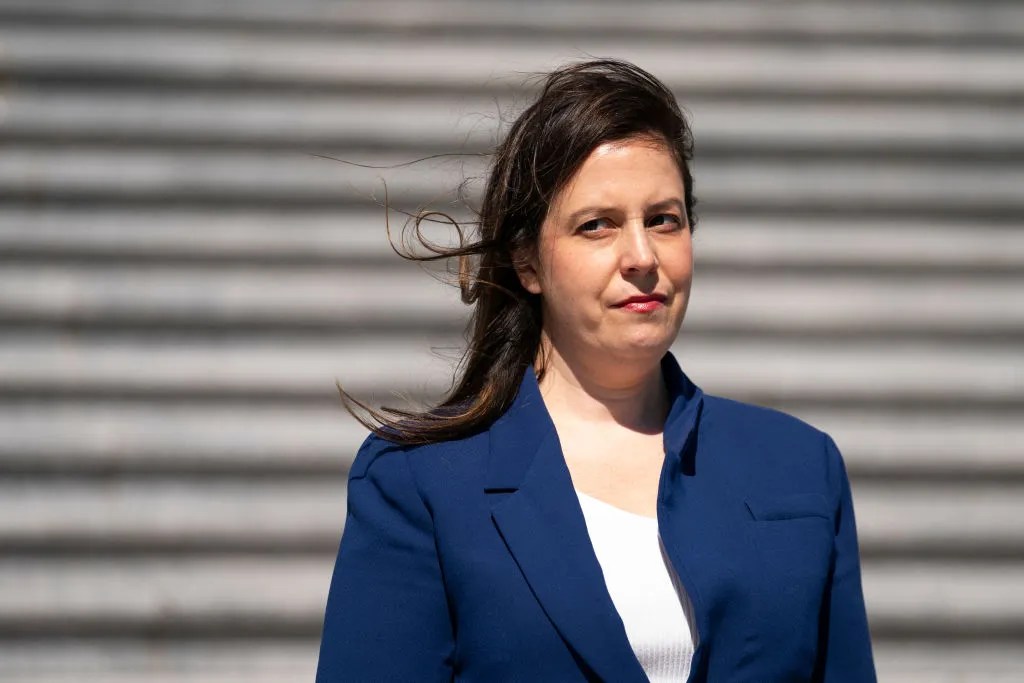
Considering the above, here are five reasons why Rep. Elise Stefanik (R-N.Y.) could be Trump’s running mate.

1. Stefanik is fighting for Trump in his New York civil fraud trial.

Playing to an audience of one, Stefanik is waging a media battle against Judge Arthur Engoron as he presides over Trump’s $250 million business fraud trial, starting with an ethics complaint against him.  

In a letter to the New York State Commission on Judicial Conduct — notably absent her congressional title — she wrote that Judge Engoron broke “several rules” in the judicial conduct code. Stefanik also called on Engoron to resign since he had shown “inappropriate bias and judicial intemperance.” 

The former president highly respects aggressive, Trumpian behavior and legal maneuvering, for which he is famous. Stefanik is thus scoring touchdowns in the VP playoffs. And she did not stop there. Again, without her title, seeking more Trump accolades and media attention, she added to her previous ethics complaint, tweeting: “Today, I’m supplementing my ethics complaint against Judge Engoron with examples of even more of his egregious misconduct after he just wrongly dismissed President Trump’s motion for a mistrial.”

With this trial maneuvering, it appears that Stefanik is playing to win the Trump “Super Bowl,” but there is more.

 2. Stefanik has a history as an unabashed Trump loyalist.

Stefanik, aware that extreme loyalty is Trump’s sweet spot, preemptively endorsed Trump for the GOP nomination more than a year ago, days ahead of his official Nov. 15, 2022 announcement. She frequently races to the microphones to defend him with her measured, articulate speaking style — not a bombastic firebrand in the mold of Rep. Marjorie Taylor Greene (R-Ga.), but like a reliable long-stemmed Bic lighter.

The depth of the Trump/Stefanik loyalty partnership was displayed this September when he consulted with her about the impending Biden impeachment inquiry. “Trump and Stefanik spoke shortly after McCarthy made the announcement,” The Hill reported. But most telling was Stefanik’s comment: “I speak to President Trump a lot.”

Her “brand” as the former president’s partner on Capitol Hill is just one more reason she would make sense on his ticket.

3. She turns 40 in 2024 and already has political credentials.

In September on NBC’s “Meet the Press,” Trump said he liked “the concept” of a female running mate. Enter Stefanik, the House Republican Conference chairwoman since 2021. She was first woman elected to Congress from northern New York at age 30 in 2014, and the youngest woman ever elected to the House at the time. Stefanik is a young, accomplished woman, a graduate of Harvard, who is Catholic and married with one child. As such, Trump might think that Stefanik on his ticket could attract more of the educated suburban female voters he lost to Biden in 2020.

Moreover, considering his own advanced age, their 38-year age difference could be an asset.

4. Stefanik would not overshadow Trump.

Stefanik is a media magnet, but she is not a wild-card attention seeker. On a Trump ticket, Stefanik would know her place and never try to overshadow him. She would likely study how former Vice President Mike Pence faded into the background (with the notable exception of Jan. 6, 2021). Whether Trump lost or won in 2024, vice presidential nominee Stefanik would strategically play the 2028 long game as the future post-Trump leader of the Republican Party.

5. She could articulate and normalize Trump’s second-term plans.

The harsh rhetoric of Trump’s second-term plans and policies will need someone more knowledgeable in policy. Stefanik could soften what might otherwise sound like a coming authoritarian presidency. Stefanik, young but tough, loyal, and intelligent, might be perceived by Team Trump as a safe, “normal” veep choice in what is likely to be an abnormal campaign, possibly foreshadowing the angriest administration in U.S. history.

Is she qualified to step into the presidency if circumstances dictate? The appropriate answer is another question: Was Trump qualified when elected in 2016? Was newly-minted Sen. Barack Obama qualified in 2008? Only voters can answer that.

Myra Adams  served on the creative team of two GOP presidential campaigns, in 2004 and 2008.


By Myra Adams – The Hill contributor

MYRA’S COMPLETE ARCHIVE IS HERE

Reposted from The Hill – Nov. 3, 2023

Note: The above image is a freeze frame of the AI generated deep-fake video mentioned in this piece.

Is the U.S. on the cusp of a three-front world war against Russia, Iran, and China? If such a seismic event were to occur, would our nation’s 50-year-old all-volunteer force require a boost from — dare I even say it? — a reinstatement of the draft?

It was Jan. 27, 1973, when most American men aged 19 to 25 were able to celebrate President Richard Nixon’s abolition of the draft. Defense Secretary Melvin Laird announced, “I wish to inform you that the Armed Forces henceforth will depend exclusively on volunteer soldiers, sailors, airmen, and Marines.”     

Although Jimmy Carter later reinstated draft registration, American men have escaped mandatory military service for two generations because millions of their patriotic brothers and sisters were willing to serve voluntarily, with thousands of them laying down their lives for their country. 

There were 2,324 military deaths in Afghanistan, along with 3,917 U.S. contractor deaths. Iraq was equally costly, with 4,431 military lives lost and 31,994 wounded. Many others still suffer from conditions such as post-traumatic stress disorder.  

Undoubtedly, the two 9/11-related wars took a toll on recruitment. One factor is a decline in patriotism. A June Gallup poll found that only 18 percent of 18- to 34-year-olds say they are “extremely proud to be American.” However, there are numerous reasons why fewer young Americans are enlisting.  

In late August, a 10-page bombshell article, “A Call to Action: Lessons from Ukraine for the Future Force,” was posted on Parameters, the Army War College’s quarterly journal. The essay explained why the “1970s concept of an all-volunteer force has outlived its shelf life and does not align with the current operating environment.”  

Katie Crombe and John A. Nagl, whose credentials cannot be lightly dismissed, wrote that “the U.S. Army is facing a dire combination of a recruiting shortfall and a shrinking Individual Ready Reserve.” The “shrink” they cite is alarming. 

“The Individual Ready Reserve, which stood at 700,000 in 1973 and 450,000 in 1994, now stands at just 76,000. These numbers cannot fill the existing gaps in the active force, let alone any casualty replacement or expansion during a large-scale combat operation.” 

As reflected in the title, the authors outline strategic “lessons from Ukraine,” including that conflict’s casualty rates, for future planning purposes. The lessons all point to their “Call to Action” for the U.S. military.

Crombe and Nagl also warn: “The technological revolution described below suggests this force has reached obsolescence. Large-scale combat operations troop requirements may well require a reconceptualization of the 1970s and 1980s volunteer force and a move toward partial conscription.”

Reinstating the draft, or “partial conscription,” would unleash powerful social, political, and cultural shock waves throughout America. After 50 years, any conscription, no matter how “partial,” would be off-the-charts contentious.

In addition to traditional ethical and constitutional concerns, it is hard even to imagine how well the “Hell no, we won’t go” of the 1960s would catch on in a modern era of social media. Many military-age youth would protest conscription as a violation of their individual liberty. Even when the draft is not deadly, it can sidetrack the lives of young men (or even women, if they are made to register) for years.

A draft may also force many to participate in activities that potentially contravene their moral, religious, or personal beliefs. Just imagine if conscription were deemed essential to help defend our ally Israel. War would break out on college campuses, would it not?

As in the Vietnam era, a draft could also disproportionately affect disadvantaged communities. Families with more resources often find ways to avoid conscription, whereas those of lesser means are more likely to bear the greater burden. Even where this doesn’t happen, the suspicion that it does will intensify resentments.

Nonetheless, with warring headlines from the Middle East, combined with Ukraine‘s lessons and warnings from Crombe and Nagl — published six weeks before Hamas attacked Israel — one imagines the Pentagon is forecasting its conscription needs, “just in case.”  

The potential for the U.S. to help defend Israel against Iran’s proxies, Hamas and Hezbollah, could turn into a more expansive and prolonged war with American boots-on-ground engagement. Simultaneously, Ukraine’s fight against its Russian invaders continues to strain American stockpiles of military hardware and ammunition that are also needed for Israel.  

Meanwhile, the Israeli conflict could negatively affect U.S. military recruitment. Even before the Hamas attack, every branch was falling short of its goals except for the smaller Marine Corps. According to the Department of Defense, for 2023, the Army is short 15,000 recruits, the Navy is down 10,000, and the Air Force 3,000.

With those statistics in mind, think back to what happened on Oct. 19 when several major news outlets were forced to fact-check a deep-fake AI video showing President Joe Biden “announcing the reinstatement of the draft.” In this video, initially posted in February, Biden appears to state that he will “invoke the Selective Service Act, as is my authority as president.” (False — that is the job of Congress.) The video concludes with Biden saying, “Remember, you are not sending your sons and daughters to war. You are sending them to freedom. God bless our troops, and God Bless Ukraine.” 

The bizarre Ukraine sign-off was another clue that the video was inauthentic. Israel was attacked on Oct. 7, and the February video resurfaced days afterward on Facebook and TikTok(You can still watch it here.)  

USA Today noted the fake short-lived draft announcement was “shared more than 400 times in four days. And “on TikTok more than 20,000 times in five days.”  

Naturally, there was outrage and profanities from those who believed Biden’s deep-fake AI-generated draft call. 

Since 1980, the Selective Service has required “men aged 18 to 25 to register” and “participate in a national draft lottery, should the President and Congress reinstate conscription due to a national emergency.” At any time, Congress could modify the law to require female registration as well.

But everyone knows that reinstating the draft will spark a fierce domestic battle, detracting from the war effort. After 50 years, a 21st-century draft would be a national nightmare. But could reinstating a draft be worse than potentially losing a major war?  

Let’s hope Americans don’t have to answer that question.    

Myra Adams served on the creative team of two GOP presidential campaigns, in 2004 and 2008. Follow her on Twitter @MyraKAdams.


By Myra Adams – The Hill contributor

MYRA’S COMPLETE ARCHIVE IS HERE

Reposted from The Hill – Oct 20, 2023

Remember the first “Jaws” movie, with the threatening, ominous music each time the audience braced for the shark to attack the boat? Today, the U.S. is on the cusp of a multi-front war. I hear the Jaws music, and the boat’s name is “America Disunited.”

Before Sept.11, 2001, our government was deaf to that iconic two-note soundtrack, failing to “connect the dots” that led to the nation’s worst terrorist attack. The U.S. was bitterly politically divided on Sept. 10, 2001, especially after a Supreme Court ruling had settled the 2000 election in favor of George W. Bush.

Yet immediately after the attacks, Americans rallied behind President George W. Bush. Houses of worship were at capacity. Before a press conference on the Capitol steps, a bipartisan gathering of House members and senators spontaneously sang “God Bless America.”

Unabashed patriotism rippled the nation, inspiring record numbers of military enlistments — the greatest recruitment boom since the 1941 Japanese attack on Pearl Harbor.

Our nation has radically changed since 2001. The polarization, fractionalization, and disunity have reached a whole new level.

Would America unite again like that if there were a comparable catastrophic 9/11 attack, foreign war crisis, or Third World War? There is a long list of reasons why such a restoration of national unity cannot be presumed possible any more. Among the many reasons that come to my mind: social media, misinformation and disinformation, the lack of an agreed-upon set of facts, “whatabout-ism,” severe distrust of government agencies, institutions and departments, and news media tailoring content to the political leanings of its viewers.

These have all contributed to a decrease in patriotism — a roadblock to unity in crisis. In March 2023, a survey found that less than 40 percent of Americans now consider patriotism very important to them, down from 70 percent in 1998.

Even more troubling is patriotism’s decline among youth. A June 2023 Gallup poll reported that only 18 percent of 18 to 34-year-olds were “extremely proud to be Americans.” Among all ages, 39 percent feel extreme pride compared to 50 percent for those over 55.

Interestingly, Gallup has linked 9/11 to a decrease in patriotism. Those who had discarded it believe it had been used to “justify expansions of the military and state surveillance,” and that it had “ushered in an era of xenophobia and abuses of power.”

At this writing, the world is a leaking gas tank, surrounded by flame throwers. Hamas’s invasion of Israel and Israel’s response could potentially engulf the entire Middle East. At the same time, the U.S. is supplying Ukraine with more lethal weapons to defend against the 21-month-long Russian invasion, including long-range missiles that would have been unthinkable a year ago.

Back from his risky high-stakes trip to Israel, President Biden asked Congress to appropriate up to a $100 billion foreign aid package for Israel, Ukraine, and Taiwan. Is Biden trying to avoid, assist, or prepare for a three-front war, requiring sustained national unity not experienced since the Second World War?

Explaining the complex reality of the $100 billion request to our allies, Senate Minority Leader Mitch McConnell (R-Ky.) said: “You’ve got the North Koreans, the Iranians, the Russians, and the Chinese, sort of, on the same side against the democratic world, so there is a connection between all of this. I am not surprised, frankly, that the administration seems to be inclined to send up a broad package.”

Already in a weak position for reelection, Biden must lead our severely fractured nation, still suffering from the 9/11-rooted war fatigue that culminated in the 2021 Afghan withdrawal debacle.

Meanwhile, FBI Director Christopher Wray has said that “we cannot and do not discount the possibility that Hamas or other foreign terrorist organizations could exploit the conflict to call on their supporters to conduct attacks on our own soil.”

Misinformation, disinformation and partisan bickering will undermine any U.S. government effort to support Israel. Now that aircraft carriers are in the region and our troops are on notice for deployment, expect a nationally organized and vocal anti-war movement to begin.

Since Hamas’s Oct. 7 surprise attack against Israel, there has been a substantial increase in pro-Palestinian activism on college campuses, in addition to antisemitic incidents, hate crimes, and the storming of a House of Representatives office building.

No matter what Biden says or does to help support and advise Israel, he will be criticized by Republicans, specifically by former President Trump and his followers. Trump’s “go-to” line is that neither the war in Israel nor Ukraine would have happened if he were president, and most GOP voters believe him.

With Trump as the likely GOP presidential nominee, every crisis scenario requiring national unity will be nearly impossible. Our enemies love how the former president foments anti-Biden sentiment and repeats misinformation. And public sentiments about democracy itself are deteriorating. How can unity ever be achieved in a crisis or war if “both Democrat and Republican voters believe it is acceptable to use violence to stop the opposing party from achieving its goals?”

Abraham Lincoln was a Republican U.S. Senate candidate from Illinois when, on June 16, 1858, he quoted Jesus: “A house divided against itself cannot stand.” It didn’t, and a bloody Civil War began in 1861.

Currently, the House of Representatives is so divided that it cannot elect a House Speaker, mirroring the state of our nation. The question is, will we stand together if a national threat demands unity? Our enemies are counting on the answer to be “no.” Can you hear the Jaws movie music?

Myra Adams served on the creative team of two GOP presidential campaigns, in 2004 and 2008.TAGS 2024 PRESIDENTIAL ELECTION DONALD TRUMP GEORGE W. BUSH ISRAEL JOE BIDEN PRESIDENT JOE BIDEN RUSSIA-UKRAINE WAR