Page 19 of 19


Posted on 12/15/17

Image impeachment 2

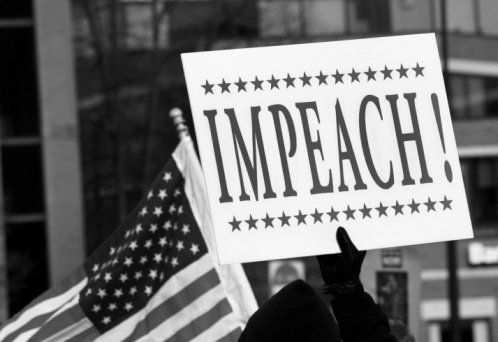
In 2018 “impeachment” will likely be the most overused word in what is shaping up to be the most contentious midterm election in modern history.

The promise of impeaching President Trump could dominate Democratic Party messaging and used to motivate hordes of anti-Trump voters to turn out and vote Democrats back into control of Capitol Hill.

Unfortunately, President Trump’s ultra-polarizing leadership style brought about his current 37 percent job approval rating, with 58 percent disapproval. This negative 21-point spread gives Democrats free rein to exploit the prospect of impeachment for self-serving political gain, whether legally justified or not. Moreover, throughout 2017, impeachment has been thoroughly embedded into the media landscape as an emotional hot-button issue and should only gain more traction in 2018.

It was back in May when I first asked the question, “Will Democrats use impeachment as their 2018 midterm message?”

Now, in December, I am confident that the answer is not only, “Yes” but “Hell yes.”

Also in that same piece, I was half-joking when I wrote that Democrats’ 2018 bumper stickers would read “You vote, we impeach.” Now, I am totally convinced that will be their call to action.

This week I asked Roger Stone, the high-profile political operative and long-time confidant of President Trump, for his thoughts on the midterm election. Stone replied: “There can be no doubt that impeachment is on the Democrats’ bucket list. Should Democrats take the House, any trumped-up charge against the president could serve as the basis for a railroad impeachment.”

Stone’s prediction is sound given that Democrats’ desire to impeach Trump began on Inauguration Day, Jan. 20, 2017, as reported in a Washington Post headline: “The campaign to impeach President Trump has begun.” And indeed it did.

Immediately swinging into action as the congressional leader of the impeachment brigade was, and still is, 79-year-old Rep. Maxine Waters, D-Calif.

Although first elected to Congress in 1991, Waters quickly learned in 2017 that impeachment is a great media-profile enhancer and effective “everywhere” for fundraising. Banging her impeachment drum not only earned Waters folk-hero status but injected new life into the twilight of her long, lackluster political career.

Competing with Waters for using impeachment as a self-enhancement vehicle is another Californian named Tom Steyer. As a billionaire former hedge fund owner, Steyer morphed from spending his millions fighting climate change to his new role as Trump’s impeachment poster-child. Starring in his own $20 million television and media campaign, Steyer’s message is:

“Donald Trump has brought us to the brink of nuclear war, obstructed justice, and taken money from foreign governments. We need to impeach this dangerous president. Sign on now.”

Steyer’s accusations are short on facts and lack evidence – but why should that matter? In what Obama’s former chief strategist David Axelrod called a “vanity project,” Steyer’s commercials, delivered in his raspy voice-of-doom-like-whisper leaves viewers with the impression that his $20 million ad campaign is as much about fueling his political ambitions as impeaching President Trump.

Comically and fittingly, the Washington Free Beacon calculated that on Dec. 6 “when Rep. Al Green, D-Texas, introduced articles of impeachment, and the House voted overwhelmingly to kill the resolution,” Green’s resolution “received just 58 votes, bringing Steyer’s bill to $344,827.59 per vote.”

Surely that cost imbalance will not stop Steyer’s quest for recognition. But, what makes someone like Steyer dangerous is when voters repeatedly see his impeachment ads, the gravity of impeachment is diminished as the most severe constitutional action against a sitting president. After all, it is human nature that the more often one hears about a potentially threatening situation or action, it tends to make that situation or action appear less threatening. And so it is with impeachment.

Barring any bombshell evidence of “treason, bribery, and other high crimes and misdemeanors” uncovered by Special Counsel Robert Mueller, Americans must be educated about the impeachment process – how it was never meant for personal political gain and could tear this nation apart. Here are two key points:

1. The vast majority of Americans are unaware that in our nation’s 241-year history no president has ever been impeached, convicted and removed from office. Not one.

The two presidents who were impeached by the House of Representatives – Andrew Johnson in 1868 and Bill Clinton in 1998 – were not convicted by the U.S. Senate of the charges filed against them. Both Johnson and Clinton remained in office until the end of their terms.

In 1974, President Richard Nixon was heading for impeachment and a likely conviction but resigned before the proceedings commenced.

Thus, at this writing, it is doubtful President Trump would be the first U.S. president to be impeached, convicted and removed from office.

2. If Democrats manage to win back control of the House of Representatives in 2018, and in 2019 by majority vote impeach President Trump on charges presented by Robert Mueller, (what Stone called “trumped-up charges”), it is highly unlikely that two-thirds of the U.S. Senate would vote to convict and remove Trump from office. Even if Democrats controlled the Senate in 2019 by a small margin, winning the votes of two-thirds of the senators is still a very high number by design of the Founding Fathers. Besides, do Democrats really want a President Pence?

Given all of the above, I stand by my prediction that impeachment will be the most overused word in 2018. Impeachment is tantamount to verbal catnip for use by Democrats who yearn for a higher media profile and a party seeking to placate a base that is demanding political payback while still reeling from devastating loses in 2016.

In our political system, absent “treason, bribery, and other high crimes and misdemeanors” the voting booth should always trump impeachment.

And with that thought in mind, remember 2020 is only 34 short months away!
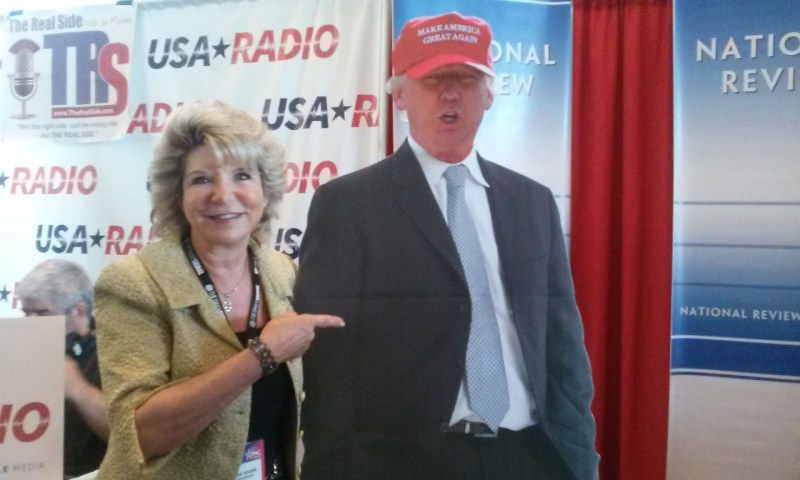

trump-and-meThe author with a Trump cut-out at CPAC March 2016. (This photo is from Myra’s personal archives and did not appear with the National Review piece below.)
Re-posted from National Review February 9, 2017

If you believe that the results of November’s presidential election have negatively impacted a personal relationship with a family member or friend, you are not alone. In fact, 40 percent of likely U.S. voters agree with this sentiment, according to a recent Rasmussen Reports survey.

Count me among that 40 percent! With political emotions running hot, family gatherings are more strained. Facebook comments are sparking feuds, and friendships are being tested. Here is a personal story.

Over the weekend a dear longtime friend from Los Angeles called me to chat about politics, as he has for decades. (He admits that everyone around him thinks like him, so he enjoys my perspective.) Often our discussions are heated because his views are usually 180 degrees from my conservative Republican leanings. During our most recent conversation, my friend said, “Don’t feel you have to defend Trump every time we talk.” That statement resonated because as a Trump voter, I want to defend the president, but Trump’s actions are making that more difficult.

For example, last week I attended the National Prayer Breakfast. In the hall afterward I agreed with a friend’s observation that “Trump gave a good speech, for Trump.” Moreover, everyone I spoke to thought the president’s speech was “adequate” but totally overshadowed by Barry Black’s keynote address. Black, the chaplain of the U.S. Senate, gave a rousing, unforgettable testimony that brought down the house, greatly impressed Trump, and dominated the post-breakfast chatter.

As previously arranged, an hour later I called a friend, an avid Trump supporter, who watched the prayer breakfast on television. After telling him that Trump’s speech was well received in the room, my friend expressed a vastly different opinion, saying, “Trump went off the teleprompter when he mentioned Schwarzenegger. It was like nails on a chalkboard.”

I was surprised and said that “Trump asking the room to pray for Arnold Schwarzenegger’s Celebrity Apprentice ratings was perceived as a joke.”

As it turned out, my friend was 100 percent correct. Trump “going off teleprompter” caused a media explosion, and Schwarzenegger struck back. In a Twitter video, Arnold sarcastically said:

“Hey Donald I have a great idea. Why don’t we switch jobs? You take over TV, because you’re such an expert in ratings, and I take over your job and then people can finally sleep comfortable again. Hmm?”

Furthermore, in a statement to ABC News, Schwarzenegger said he is “praying that President Trump can start improving his own approval ratings.”

Here is why I have a difficult time defending President Trump — the man has yet to realize that he is president of the United States when the day after the prayer breakfast he tweeted, at 6:30 a.m.:

“Yes, Arnold Schwarzenegger did a really bad job as Governor of California and even worse on the Apprentice . . . but at least he tried hard!”

Unfortunately, in the media, the solemn annual bipartisan National Prayer Breakfast was reduced to a backdrop for a Donald-vs.-Arnold celebrity feud, with the prayer breakfast sustaining collateral damage.

The larger question concerns whether President Trump is ever going to learn that as president of the United States he must never engage in petty public personal attacks against anyone. Such attacks make him and the office of the president look small. Just imagine if President Trump had ignored Arnold’s responses. Then Trump would have looked presidential, and Arnold would have been reduced in stature, for attacking the president.

But Trump’s personal Twitter attacks continued. On Saturday morning, February 4, Trump attacked federal Judge James Robart, a George W. Bush appointee, who temporarily stopped the president’s controversial travel ban Friday night. Trump tweeted:

“The opinion of this so-called judge, which essentially takes law-enforcement away from our country, is ridiculous and will be overturned!”

Yes, that bright, shiny tweet deflected the media’s attention from the Schwarzenegger feud. However, President Trump’s personal attack on a judge was perceived as an assault against a co-equal branch of government — far more serious than a tweet fight over ratings.

Yesterday a department store was the target of one of Trump’s Twitter tirades, as he lashed out at Nordstrom for dropping his daughter Ivanka’s fashion line (from which she stepped down as CEO in January). He tweeted:

“My daughter Ivanka has been treated so unfairly by @Nordstrom. She is a great person — always pushing me to do the right thing! Terrible!”

Clearly Nordstrom crossed what I call a “fashion line in the sand,” forcing White House press secretary Sean Spicer to defend the president’s tweet by saying that Trump “has every right to stand up for his family.”

In my good conscience, I can’t defend a president who does not understand the power of his office. I want President Trump to be successful and to make “America great again.” I am his “base.” But if Trump thinks childish actions are pleasing to all of his base, he is sadly mistaken.

President Trump is an impulsive entertainer, and his going off teleprompter can have dangerous consequences. He has yet to learn that as president, he speaks and writes words that can turn into weapons, and weapons start wars, foreign as well as domestic.

As president of a polarized nation where close relationships are being strained, Trump needs to be the president of all Americans, not just base voters who are more forgiving.

Trump has now twisted the famous words of President Teddy Roosevelt, “Speak softly and carry a big stick,” by speaking loudly and carrying dynamite. Trump can still earn the respect of the American people, by staying on his teleprompter and shutting down his Twitter account. Above all, he must remember that he is the most powerful man in the world, and he should start acting accordingly.


h-sign

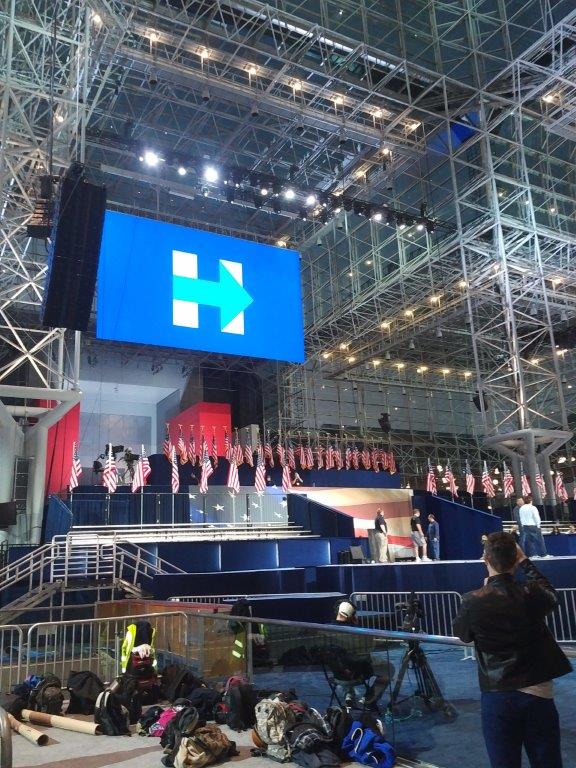
Stage on Nov. 7. “What if she loses?” I thought.  (Credit: Myra Adams)

Re-posted from  Washington Examiner.

The first public sign that Hillary Clinton’s campaign was unsure of victory was when they canceled the fireworks scheduled for 9 p.m. on election night.

As it turned out, there were fireworks on Nov. 8, but not from a barge on the Hudson River. Instead, it was political fireworks exploding after the greatest upset in modern presidential history. The degree of the upset was further accentuated by the enormity of the physical site chosen for Clinton’s victory party, the Javits Center in Manhattan.

Keeping with Clinton’s theme of becoming the first female president, Javits offered a gargantuan glass ceiling to hammer home the meaning of her impending victory.

As the New York Times reported, “The symbolism seems clear. Mrs. Clinton has referred repeatedly of busting through ‘the highest, hardest glass ceiling’ — at least figuratively — by installing a woman in the Oval Office. If Election Day breaks her way, she will address the nation beneath a literal one.”

It would have been a perfect photo opportunity. One could imagine Katy Perry’s song “Roar” playing in the background, with Clinton hoarse from yelling the names of all the famous women who helped her break the gargantuan glass ceiling that towered above.

But, as I am fond of saying, “How do you make God laugh? Tell him your plans.” God definitely had a different plan for that evening. Clinton could never have imagined she wouldn’t even enter Javits on election night.

Besides the symbolic glass ceiling, the selection of Javits signaled Team Clinton’s total confidence that victory was assured.

My first visit to Javits was on Monday when I picked up my press credential. I was astounded by what I saw. It looked like grand scale preparations for a national nominating convention with an assumed outcome rather than an event where the outcome was undetermined.

The streets were already blocked, causing traffic havoc with battalions of police ready for anything. Hundreds of journalists were already at their battle stations and rows of satellite trucks lined the streets

In the back of my mind, I kept thinking, “What if there is a surprise? What if she loses?” The stage was lined with flags, with a predominant “H” symbol hovering over it all. The possibility of a major upset was resonating with me since that morning when a friend in Donald Trump’s inner circle was extremely confident of victory.

Thanks to that conversation, coupled with the canceled fireworks, I looked at the activity in Javits through a different lens, with the word “arrogance” swirling in my brain.

On the afternoon of Election Day, I again arrived at Javits. It was no easy feat after negotiating my way through an armed camp and what felt like miles of walking.

The buzz in the air allowed for only one possible outcome. Defeat was not even a remote possibility. The election had already been won. Time to party!

But as we know now, voters had their say. Later that night, I saw grown men cry and staffers hugging each other for comfort. No one in the Javits Center could believe the defeat that was unfolding across Clinton’s “blue firewall” in the industrial midwest.

Maybe it was just a coincidence, but the large screens throughout Javits and in the media filing room kept cutting away from the harsh reality of actual voting results to play Clinton’s “fighting for women and children” propaganda videos. Furthermore, the election night broadcasts were continually interrupted by footage from the rally just outside. That’s where notables like Sen. Chuck Schumer, D-N.Y., were leading the crowd in a continuous chant of “I believe that she will win!”

Schumer’s chanting did not make it so. More than half of the American people made it abundantly clear they did not want the Clinton family back in the White House. Trump won just enough votes in key battleground states to earn an impressive Electoral College victory while Clinton suffers the pain of winning the popular vote by the smallest margin of 47.7 percent to Trump’s 47.5.

Now, instead of planning for the transition and inauguration, Clinton is fading away from the public eye. Perhaps she is just sitting around, hoping President Obama will pardon her from any possible crimes relating to her emails.

In a matter of days, the Clinton campaign morphed from assuming a coronation to hoping for a presidential pardon. Arrogance is the word that links the two.

Me on H stage.jpg

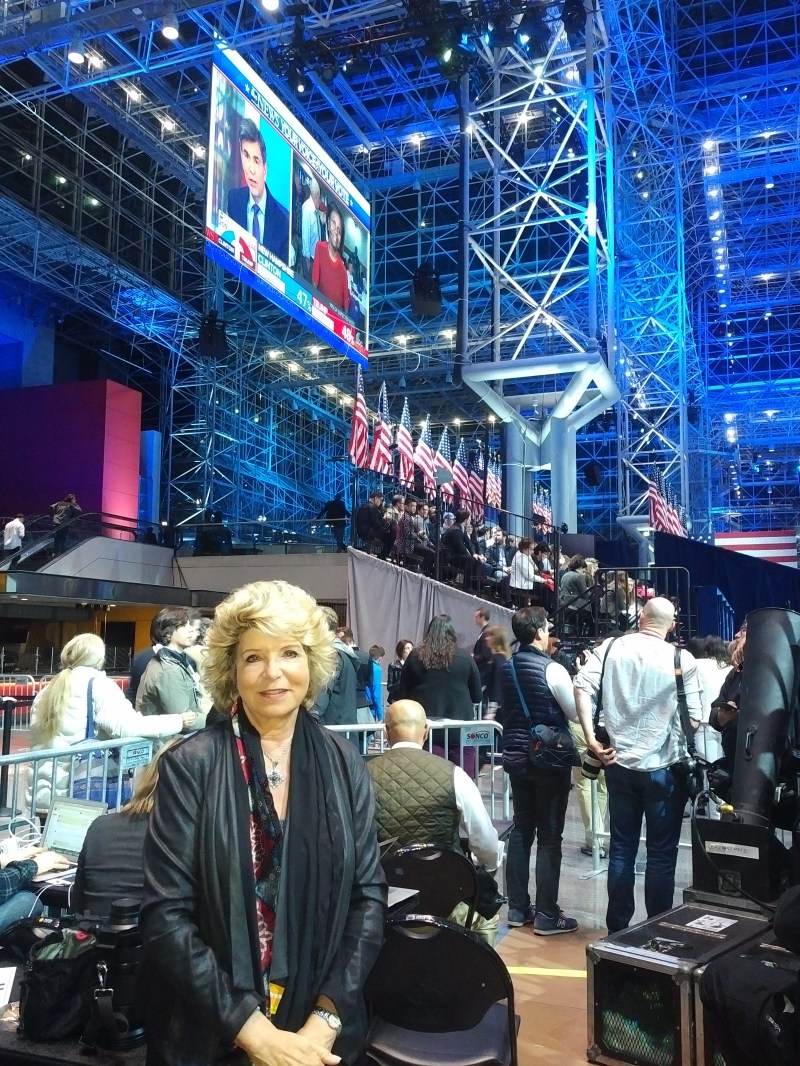
The author behind enemy lines on Election Night at Hillary ‘s “victory party.”

Myra Adams is a media producer and writer who served on the McCain Ad Council during the 2008 McCain campaign and on the 2004 Bush campaign creative team. Her writing credits include National Review, WND, Washington Examiner, Breitbart, PJ Media, The Daily Beast, The Daily Caller, RedState, BizPacReview and Liberty Unyielding. E-mail her at MyraAdams01@gmail.com. Follow her on Twitter @MyraKAdams.