Page 6 of 17


By Myra Adams – The Hill contributor

MYRA’S COMPLETE ARCHIVE IS HERE

Reposted from The Hill – Dec. 22, 2023

Raise your hand if you are dreading 2024. Keep it up if you believe it will be more traumatic than 2023.

As I was writing this piece, the news broke that the Colorado Supreme Court had ruled former President Trump is ineligible to appear on the 2024 presidential ballot, citing the Constitution’s 14th Amendment insurrection clause.

This unprecedented ruling, likely headed to the Supreme Court, illustrates how alarming, destructive, distressing events and circumstances from 2023 will continue unabated or conclude with more polarizing or dangerous consequences. Thus, 2024 could rank among the most harrowing and catastrophic in national and world history based on the following 11 “what if” questions.

1. What if a barrage of AI-generated content and social media from domestic and foreign players blur presidential campaign messaging, so that voters don’t know what is real or fake?

In April, a member of Congress stated that Russia, China and Iran prefer Trump to win over President Biden. If true, consider a chilling report from the Microsoft Threat Analysis Center, entitled “Protecting Election 2024 from foreign malign influence.” Microsoft warns that a vast operation will target and manipulate voters through extensive foreign AI, cyber, website disinformation and social media. Be aware: A toxic stew of nefarious foreign players will try to influence your vote.

2. What if House Republicans vote to impeach President Biden?

Last week’s party-line vote approved an impeachment inquiry against President Biden. By spring, if House Speaker Johnson counts enough Republican votes to pass articles of impeachment, our nation will experience its first back-to-back impeachments against successive presidents.

Democrats consider this GOP impeachment effort political theatre directed by Donald Trump. Therefore, Biden could have a unique opportunity to show strength, fight back and appeal to voters who think he is too old. And like Trump, Biden could count on an acquittal after his Senate trial.

Furthermore, what if House GOP leaders find insufficient evidence to move forward with articles of impeachment or are short of votes to impeach? Call that a politically embarrassing debacle, perhaps followed by a face-saving “Let the voters decide.” Such a pro-democracy-sounding spin message could be the end-game for this “revenge impeachment.” Undoubtedly, Trump would be furious if Biden were not impeached and lash out at the “weak” House leadership.

3. What if Biden drops out?

That unlikely but not implausible scenario would be the political equivalent of a nuclear bomb, changing the course of American history. Vice President Kamala Harris would be tough to dethrone, but unpopular and potentially beatable by Trump.

4. What if the Supreme Court rules that Trump has presidential immunity and can not stand trial on Jan. 6-related charges?

Such a ruling would be a constitutional shock to our nation and damaging to the Supreme Court’s reputation. According to George Washington University law professor Paul Schiff Berman, granting Trump immunity for criminal action while in office “goes more to the heart of whether the president is a president or a king.”

In 2024, there is no “what if,” only a series of how Trump-related Supreme Court rulings will impact and influence the presidential election.

5. What if Trump is convicted of a felony before November’s election, and polls show he still defeats Biden?

Fortunately for Trump, the Constitution does not state that a criminal conviction makes one ineligible to hold the nation’s highest office. Therefore, again, “Let the voters decide” resolves that question.

6. What if the economy keeps improving and growing with a strong stock market while inflation, interest rates and unemployment all trend lower?  

Would a strong economy translate into higher job approval for President Biden? Not necessarily. If the cost of living is still perceived as too high and the southern border immigration crisis is uncontrollable, Biden could well become a one-term president even amid a recovery.

Recently, Trump unveiled his new campaign slogan: “Better Off With Trump.” It is a personal and narcissistic twist on the traditional presidential election question: “Are you better off than you were four years ago?” Theoretically, the answer should be “yes,” since the pandemic began in 2020. Nonetheless, Trump’s communication machine and savvy showmanship skills are light years beyond Biden’s, and more voters will be thinking “No.”

7. What if Trump’s campaign rhetoric continues to sound authoritarian as he leads Biden in the polls?

The more Trump quotes his favorite dictators, the more his unorthodox speech becomes normalized and acceptable to voters. At last weekend’s New Hampshire rally, Trump unabashedly said: “Even Vladimir Putin says that Biden’s — and this is a quote — ‘politically motivated persecution of his political rival is very good for Russia, because it shows the rottenness of the American political system, which cannot pretend to teach others about democracy.’”

Trump is brilliantly employing political jujutsu with all-caps campaign signs proclaiming that “BIDEN ATTACKS DEMOCRACY.” Voters cheer because Trump is their strong man who promises, “We’re going to bring our country back from hell. It’s in hell.”

8. What if the U.S. is drawn into a Middle East war against Iran-backed groups that continue to provoke U.S. naval ships and disrupt international commercial shipping?

Speaking of hell… The Houthis are warning that their attacks will continue. How will the U.S. and its allies stop this naval and merchant ship crisis without further escalation?

9. What if, without U.S. aid, Ukraine falls to Russia?

Putin’s mission is to reconstitute the Soviet empire. If the U.S. abandons Ukraine, we will pay more later and show the world that the U.S. is an unreliable ally.

10. What if war explodes on three fronts?

What if China takes advantage of the distractions in the Middle East and Ukraine to invade Taiwan? Chinese President Xi recently warned Biden that timing is the only question.

11. What if there is a terrorist attack in the U.S., and the perpetrators(s) enter over the southern border?

According to the U.S. Border Patrol Terrorist Screening Dataset, this is an increasing threat. Should it happen, say hello to President Donald J. Trump. But no worries, He will only be a “dictator on day one.”

Potentially, 2024 will rival the domestic upheaval of 1968 and the international threats of 1939. Brace yourself for double chaos.

Myra Adams served on the creative team of two GOP presidential campaigns in 2004 and 2008.

TAGS 2024 DONALD TRUMP JOE BIDEN KAMALA HARRIS PRESIDENT JOE BIDEN


By Myra Adams – The Hill contributor

MYRA’S COMPLETE ARCHIVE IS HERE

When Capitol building cleaning crews were removing feces from the hallowed halls of Congress after the riot of Jan. 6, 2021, no one imagined that Donald Trump would be leading the 2024 Republicanpresidential primary field by a 48-point margin just three years later.

Two overarching reasons help explain this unusual circumstance.

First, his “Make America Great Again” base is immovable. Trump knew that already on Jan. 23, 2016, when at a rally in Iowa, he famously stated, “I could stand in the middle of Fifth Avenue and shoot somebody, and I wouldn’t lose any voters. Okay?” This is, for example, why Trump can be so comfortable with careless conversations about the executive orders he wants to sign at the beginning of his second term, telling Sean Hannity that he would not be a dictator, “other than day one.”

Second, May poll data found that six out of ten Republicans still think the 2020 election was illegitimate. No wonder, since at his Iowa rally last Saturday, Trump repeatedly told the crowd that Democrats “rigged and stole the 2020 election.”

This delusion has poisoned Trump voters’ minds in seven distinct ways.

1. Deceptive Rationalization

Whatever Trump says or does, no matter the evidence to the contrary, his loyal followers normalize, downplay, excuse, and rationalize his behaviors, speech, and legal issues. Indeed, any of dozens of instances of his controversial behavior would have doomed any traditional presidential candidate before June 2015, when he first descended the Trump Tower escalator.

No “traditional” presidential candidate could have survived two impeachments, indictments on 91 felony counts, and numerous investigations without the magic spell of deceptive rationalization. That is the superstructure reinforcing Trump’s movement.

Among my Trump-loyal friends, I often hear rationalizations such as, “I don’t like his personality, but I like his policies,” and “Our nation was stronger when he was president.”

When I ask, “What about Jan. 6, 2021?” the answer is, “That was overblown.” I say, “What about his trying to overturn the Constitution to stay in power?” The retort is, “It was justified, since the election was stolen.” Finally, I ask, “How about all his indictments?” Answer: “It is a Democrat scam to keep him from winning in 2024.”  

Deceptive rationalization is the unbreakable feedback loop between Trump and his followers. Trump is perpetually the innocent victim who cannot lose or fail, and the star who always rises, vowing to undo any wrongs, improve your life, and strengthen the nation.

2. Respect for the strong-man image

American masculinity is under attack. Trump appeals to the MAGA mindset by exemplifying the 20th-century fighting persona of great American manhood. To his fans, he is John Wayne or Rocky Balboa, someone who takes no crap and fights to the end. A Trump voter told me, “Only Trump has the courage to stand up to his enemies. He is not bought or owned by lobbyists. He can be trusted to do what is best for America.”

In the mind of MAGA voters, the 2024 election might be characterized as “Trump is strong, and Biden is weak.” And Trump’s “dictator” remark only solidifies this popular strongman image.

3. Biden is much worse than Trump

When I discussed Trump’s dictatorial language with Trump-voting friends, one said, “Biden is not an option.” Another remarked, “I’ll take Trump any day over Biden. He is better than what we have now.”

The right-leaning media echo chamber has made Trump a respectable alternative to Biden. Furthermore, Republicans are more enthusiastic about voting in 2024, so Trump can undo the damage Biden has done. Trump equals hope for America. Biden means disaster.

Sen. Lindsey Graham (R-S.C.) piled on last Sunday, stating that if Biden is reelected, “then we won’t recognize America and the world will be truly on fire.”

4. Whataboutism

Comparing Trump to Biden and his son Hunter is a favorite MAGA mind game. For every controversial Trump action, there is a Biden equivalent that evens the playing field. Trump and his voters believe Biden has weaponized the government, most notably the Justice Department.

On Tuesday, when Hannity asked Trump if he would “use the government to go after people,” Trump retorted, “You mean like they’re using right now?” He thus expertly applied his “whataboutism” skill to justify his authoritarian-sounding second-term proposals as a means to saving America and democracy.   

This is not accidental. At his recent Iowa rally, Trump said, “Joe Biden is the destroyer of American democracy,” and Trump’s campaign distributed all-caps signs reading, “BIDEN ATTACKS DEMOCRACY.” The 2024 “whataboutism” battle is intentional, and it will be fierce.

5. Rural/blue-collar America gives its middle finger to governmental authority

For Trump’s supporters, he personifies turning the tables on authority with a stick it to the boss” mentality. Ironically, Trump vows to replace authority with more authority, loyal only to him.

6. Trump represents an America First policy agenda that gets things done.

In Iowa last week, as before, Trump bragged, “I kept Israel safe. I kept Ukraine safe. None of this stuff would have happened. And I kept the entire world safe….And as the 47th president…we will do it again.” And the crowds cheer wildly.

7. Us-versus-Them mentality

“We pledge to you that we will root out the communists, Marxists, fascists, and the radical left thugs that live like vermin within the confines of our country, that lie and steal and cheat on elections,” Trump said on Nov. 11 in New Hampshire.

A Trump-loyal friend emailed, “I have heard many times on Fox that Washington is portraying Trump as a Hitler. No one is listening to reporters.”

Are MAGA voters deaf to Trump’s own words?

Presumably, any non-Trump voter could be included in the “them” whom Trump described on Nov.11. Still, his followers believe the “Trump is a dictator talk” to be “patently absurd,” perpetrated by a liberal media freaking out over Trump potentially returning to power. Given the extreme us-versus-them polarization, it is doubtful that Trump’s “dictator” remarks will change any votes.

My safe 2024 prediction: The losing party will believe it is “the end of America.”

Myra Adams served on the creative team of two GOP presidential campaigns, in 2004 and 2008TAGS 2024 PRESIDENTIAL ELECTION DONALD TRUMP JOE BIDEN PRESIDENT JOE BIDEN


By Myra Adams – The Hill contributor

MYRA’S COMPLETE ARCHIVE IS HERE

Reposted from The Hill – Nov. 24, 2023

At this point in the 2024 presidential election cycle, it appears that former President Donald Trump will win the Republican nomination without breaking a sweat or even participating in a single primary debate.

Then, after the first of the year, if Trump wins the early primary states of IowaNew Hampshire, and South Carolina — he leads in all three with a poll average of around 30 percentage points — then expect a quick shift to the new question: “Whom will Trump choose as his running mate?” Since the 22nd Amendment states that “No person shall be elected to the office of the President more than twice,” that question has political implications beyond the usual drama.

Should Trump win in 2024, his vice president will instantly become the leading GOP candidate for 2028. Furthermore, potentially halfway through his term, Trump will turn 80. Given the vice president’s most crucial role in case of emergency, his running mate will thus enhance or detract from the ticket.

It is common political knowledge that Trump loves to dominate the news cycle, foster chaos and demand loyalty. He also wants to win the White House to avenge his 2020 loss and punish his enemies. Therefore, his running mate must bring significant assets to the ticket — similar to 2016, when then-Indiana Gov. Mike Pence helped deliver droves of evangelical voters somewhat skeptical of Trump’s political and personal history.

Considering the above, here are five reasons why Rep. Elise Stefanik (R-N.Y.) could be Trump’s running mate.

1. Stefanik is fighting for Trump in his New York civil fraud trial.

Playing to an audience of one, Stefanik is waging a media battle against Judge Arthur Engoron as he presides over Trump’s $250 million business fraud trial, starting with an ethics complaint against him.  

In a letter to the New York State Commission on Judicial Conduct — notably absent her congressional title — she wrote that Judge Engoron broke “several rules” in the judicial conduct code. Stefanik also called on Engoron to resign since he had shown “inappropriate bias and judicial intemperance.” 

The former president highly respects aggressive, Trumpian behavior and legal maneuvering, for which he is famous. Stefanik is thus scoring touchdowns in the VP playoffs. And she did not stop there. Again, without her title, seeking more Trump accolades and media attention, she added to her previous ethics complaint, tweeting: “Today, I’m supplementing my ethics complaint against Judge Engoron with examples of even more of his egregious misconduct after he just wrongly dismissed President Trump’s motion for a mistrial.”

With this trial maneuvering, it appears that Stefanik is playing to win the Trump “Super Bowl,” but there is more.

 2. Stefanik has a history as an unabashed Trump loyalist.

Stefanik, aware that extreme loyalty is Trump’s sweet spot, preemptively endorsed Trump for the GOP nomination more than a year ago, days ahead of his official Nov. 15, 2022 announcement. She frequently races to the microphones to defend him with her measured, articulate speaking style — not a bombastic firebrand in the mold of Rep. Marjorie Taylor Greene (R-Ga.), but like a reliable long-stemmed Bic lighter.

The depth of the Trump/Stefanik loyalty partnership was displayed this September when he consulted with her about the impending Biden impeachment inquiry. “Trump and Stefanik spoke shortly after McCarthy made the announcement,” The Hill reported. But most telling was Stefanik’s comment: “I speak to President Trump a lot.”

Her “brand” as the former president’s partner on Capitol Hill is just one more reason she would make sense on his ticket.

3. She turns 40 in 2024 and already has political credentials.

In September on NBC’s “Meet the Press,” Trump said he liked “the concept” of a female running mate. Enter Stefanik, the House Republican Conference chairwoman since 2021. She was first woman elected to Congress from northern New York at age 30 in 2014, and the youngest woman ever elected to the House at the time. Stefanik is a young, accomplished woman, a graduate of Harvard, who is Catholic and married with one child. As such, Trump might think that Stefanik on his ticket could attract more of the educated suburban female voters he lost to Biden in 2020.

Moreover, considering his own advanced age, their 38-year age difference could be an asset.

4. Stefanik would not overshadow Trump.

Stefanik is a media magnet, but she is not a wild-card attention seeker. On a Trump ticket, Stefanik would know her place and never try to overshadow him. She would likely study how former Vice President Mike Pence faded into the background (with the notable exception of Jan. 6, 2021). Whether Trump lost or won in 2024, vice presidential nominee Stefanik would strategically play the 2028 long game as the future post-Trump leader of the Republican Party.

5. She could articulate and normalize Trump’s second-term plans.

The harsh rhetoric of Trump’s second-term plans and policies will need someone more knowledgeable in policy. Stefanik could soften what might otherwise sound like a coming authoritarian presidency. Stefanik, young but tough, loyal, and intelligent, might be perceived by Team Trump as a safe, “normal” veep choice in what is likely to be an abnormal campaign, possibly foreshadowing the angriest administration in U.S. history.

Is she qualified to step into the presidency if circumstances dictate? The appropriate answer is another question: Was Trump qualified when elected in 2016? Was newly-minted Sen. Barack Obama qualified in 2008? Only voters can answer that.

Myra Adams  served on the creative team of two GOP presidential campaigns, in 2004 and 2008.


By Myra Adams – The Hill contributor

MYRA’S COMPLETE ARCHIVE IS HERE

Reposted from The Hill – Nov. 3, 2023

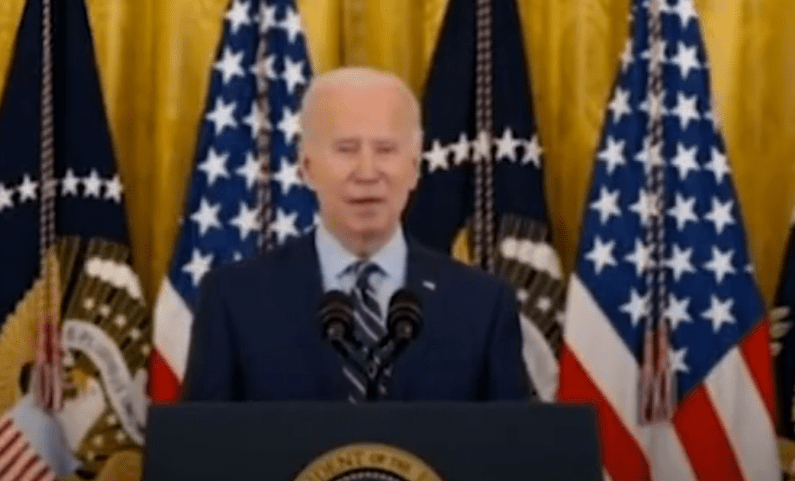
Note: The above image is a freeze frame of the AI generated deep-fake video mentioned in this piece.

Is the U.S. on the cusp of a three-front world war against Russia, Iran, and China? If such a seismic event were to occur, would our nation’s 50-year-old all-volunteer force require a boost from — dare I even say it? — a reinstatement of the draft?

It was Jan. 27, 1973, when most American men aged 19 to 25 were able to celebrate President Richard Nixon’s abolition of the draft. Defense Secretary Melvin Laird announced, “I wish to inform you that the Armed Forces henceforth will depend exclusively on volunteer soldiers, sailors, airmen, and Marines.”     

Although Jimmy Carter later reinstated draft registration, American men have escaped mandatory military service for two generations because millions of their patriotic brothers and sisters were willing to serve voluntarily, with thousands of them laying down their lives for their country. 

There were 2,324 military deaths in Afghanistan, along with 3,917 U.S. contractor deaths. Iraq was equally costly, with 4,431 military lives lost and 31,994 wounded. Many others still suffer from conditions such as post-traumatic stress disorder.  

Undoubtedly, the two 9/11-related wars took a toll on recruitment. One factor is a decline in patriotism. A June Gallup poll found that only 18 percent of 18- to 34-year-olds say they are “extremely proud to be American.” However, there are numerous reasons why fewer young Americans are enlisting.  

In late August, a 10-page bombshell article, “A Call to Action: Lessons from Ukraine for the Future Force,” was posted on Parameters, the Army War College’s quarterly journal. The essay explained why the “1970s concept of an all-volunteer force has outlived its shelf life and does not align with the current operating environment.”  

Katie Crombe and John A. Nagl, whose credentials cannot be lightly dismissed, wrote that “the U.S. Army is facing a dire combination of a recruiting shortfall and a shrinking Individual Ready Reserve.” The “shrink” they cite is alarming. 

“The Individual Ready Reserve, which stood at 700,000 in 1973 and 450,000 in 1994, now stands at just 76,000. These numbers cannot fill the existing gaps in the active force, let alone any casualty replacement or expansion during a large-scale combat operation.” 

As reflected in the title, the authors outline strategic “lessons from Ukraine,” including that conflict’s casualty rates, for future planning purposes. The lessons all point to their “Call to Action” for the U.S. military.

Crombe and Nagl also warn: “The technological revolution described below suggests this force has reached obsolescence. Large-scale combat operations troop requirements may well require a reconceptualization of the 1970s and 1980s volunteer force and a move toward partial conscription.”

Reinstating the draft, or “partial conscription,” would unleash powerful social, political, and cultural shock waves throughout America. After 50 years, any conscription, no matter how “partial,” would be off-the-charts contentious.

In addition to traditional ethical and constitutional concerns, it is hard even to imagine how well the “Hell no, we won’t go” of the 1960s would catch on in a modern era of social media. Many military-age youth would protest conscription as a violation of their individual liberty. Even when the draft is not deadly, it can sidetrack the lives of young men (or even women, if they are made to register) for years.

A draft may also force many to participate in activities that potentially contravene their moral, religious, or personal beliefs. Just imagine if conscription were deemed essential to help defend our ally Israel. War would break out on college campuses, would it not?

As in the Vietnam era, a draft could also disproportionately affect disadvantaged communities. Families with more resources often find ways to avoid conscription, whereas those of lesser means are more likely to bear the greater burden. Even where this doesn’t happen, the suspicion that it does will intensify resentments.

Nonetheless, with warring headlines from the Middle East, combined with Ukraine‘s lessons and warnings from Crombe and Nagl — published six weeks before Hamas attacked Israel — one imagines the Pentagon is forecasting its conscription needs, “just in case.”  

The potential for the U.S. to help defend Israel against Iran’s proxies, Hamas and Hezbollah, could turn into a more expansive and prolonged war with American boots-on-ground engagement. Simultaneously, Ukraine’s fight against its Russian invaders continues to strain American stockpiles of military hardware and ammunition that are also needed for Israel.  

Meanwhile, the Israeli conflict could negatively affect U.S. military recruitment. Even before the Hamas attack, every branch was falling short of its goals except for the smaller Marine Corps. According to the Department of Defense, for 2023, the Army is short 15,000 recruits, the Navy is down 10,000, and the Air Force 3,000.

With those statistics in mind, think back to what happened on Oct. 19 when several major news outlets were forced to fact-check a deep-fake AI video showing President Joe Biden “announcing the reinstatement of the draft.” In this video, initially posted in February, Biden appears to state that he will “invoke the Selective Service Act, as is my authority as president.” (False — that is the job of Congress.) The video concludes with Biden saying, “Remember, you are not sending your sons and daughters to war. You are sending them to freedom. God bless our troops, and God Bless Ukraine.” 

The bizarre Ukraine sign-off was another clue that the video was inauthentic. Israel was attacked on Oct. 7, and the February video resurfaced days afterward on Facebook and TikTok(You can still watch it here.)  

USA Today noted the fake short-lived draft announcement was “shared more than 400 times in four days. And “on TikTok more than 20,000 times in five days.”  

Naturally, there was outrage and profanities from those who believed Biden’s deep-fake AI-generated draft call. 

Since 1980, the Selective Service has required “men aged 18 to 25 to register” and “participate in a national draft lottery, should the President and Congress reinstate conscription due to a national emergency.” At any time, Congress could modify the law to require female registration as well.

But everyone knows that reinstating the draft will spark a fierce domestic battle, detracting from the war effort. After 50 years, a 21st-century draft would be a national nightmare. But could reinstating a draft be worse than potentially losing a major war?  

Let’s hope Americans don’t have to answer that question.    

Myra Adams served on the creative team of two GOP presidential campaigns, in 2004 and 2008. Follow her on Twitter @MyraKAdams.


By Myra Adams – The Hill contributor

MYRA’S COMPLETE ARCHIVE IS HERE

Reposted from The Hill – Oct 20, 2023

Remember the first “Jaws” movie, with the threatening, ominous music each time the audience braced for the shark to attack the boat? Today, the U.S. is on the cusp of a multi-front war. I hear the Jaws music, and the boat’s name is “America Disunited.”

Before Sept.11, 2001, our government was deaf to that iconic two-note soundtrack, failing to “connect the dots” that led to the nation’s worst terrorist attack. The U.S. was bitterly politically divided on Sept. 10, 2001, especially after a Supreme Court ruling had settled the 2000 election in favor of George W. Bush.

Yet immediately after the attacks, Americans rallied behind President George W. Bush. Houses of worship were at capacity. Before a press conference on the Capitol steps, a bipartisan gathering of House members and senators spontaneously sang “God Bless America.”

Unabashed patriotism rippled the nation, inspiring record numbers of military enlistments — the greatest recruitment boom since the 1941 Japanese attack on Pearl Harbor.

Our nation has radically changed since 2001. The polarization, fractionalization, and disunity have reached a whole new level.

Would America unite again like that if there were a comparable catastrophic 9/11 attack, foreign war crisis, or Third World War? There is a long list of reasons why such a restoration of national unity cannot be presumed possible any more. Among the many reasons that come to my mind: social media, misinformation and disinformation, the lack of an agreed-upon set of facts, “whatabout-ism,” severe distrust of government agencies, institutions and departments, and news media tailoring content to the political leanings of its viewers.

These have all contributed to a decrease in patriotism — a roadblock to unity in crisis. In March 2023, a survey found that less than 40 percent of Americans now consider patriotism very important to them, down from 70 percent in 1998.

Even more troubling is patriotism’s decline among youth. A June 2023 Gallup poll reported that only 18 percent of 18 to 34-year-olds were “extremely proud to be Americans.” Among all ages, 39 percent feel extreme pride compared to 50 percent for those over 55.

Interestingly, Gallup has linked 9/11 to a decrease in patriotism. Those who had discarded it believe it had been used to “justify expansions of the military and state surveillance,” and that it had “ushered in an era of xenophobia and abuses of power.”

At this writing, the world is a leaking gas tank, surrounded by flame throwers. Hamas’s invasion of Israel and Israel’s response could potentially engulf the entire Middle East. At the same time, the U.S. is supplying Ukraine with more lethal weapons to defend against the 21-month-long Russian invasion, including long-range missiles that would have been unthinkable a year ago.

Back from his risky high-stakes trip to Israel, President Biden asked Congress to appropriate up to a $100 billion foreign aid package for Israel, Ukraine, and Taiwan. Is Biden trying to avoid, assist, or prepare for a three-front war, requiring sustained national unity not experienced since the Second World War?

Explaining the complex reality of the $100 billion request to our allies, Senate Minority Leader Mitch McConnell (R-Ky.) said: “You’ve got the North Koreans, the Iranians, the Russians, and the Chinese, sort of, on the same side against the democratic world, so there is a connection between all of this. I am not surprised, frankly, that the administration seems to be inclined to send up a broad package.”

Already in a weak position for reelection, Biden must lead our severely fractured nation, still suffering from the 9/11-rooted war fatigue that culminated in the 2021 Afghan withdrawal debacle.

Meanwhile, FBI Director Christopher Wray has said that “we cannot and do not discount the possibility that Hamas or other foreign terrorist organizations could exploit the conflict to call on their supporters to conduct attacks on our own soil.”

Misinformation, disinformation and partisan bickering will undermine any U.S. government effort to support Israel. Now that aircraft carriers are in the region and our troops are on notice for deployment, expect a nationally organized and vocal anti-war movement to begin.

Since Hamas’s Oct. 7 surprise attack against Israel, there has been a substantial increase in pro-Palestinian activism on college campuses, in addition to antisemitic incidents, hate crimes, and the storming of a House of Representatives office building.

No matter what Biden says or does to help support and advise Israel, he will be criticized by Republicans, specifically by former President Trump and his followers. Trump’s “go-to” line is that neither the war in Israel nor Ukraine would have happened if he were president, and most GOP voters believe him.

With Trump as the likely GOP presidential nominee, every crisis scenario requiring national unity will be nearly impossible. Our enemies love how the former president foments anti-Biden sentiment and repeats misinformation. And public sentiments about democracy itself are deteriorating. How can unity ever be achieved in a crisis or war if “both Democrat and Republican voters believe it is acceptable to use violence to stop the opposing party from achieving its goals?”

Abraham Lincoln was a Republican U.S. Senate candidate from Illinois when, on June 16, 1858, he quoted Jesus: “A house divided against itself cannot stand.” It didn’t, and a bloody Civil War began in 1861.

Currently, the House of Representatives is so divided that it cannot elect a House Speaker, mirroring the state of our nation. The question is, will we stand together if a national threat demands unity? Our enemies are counting on the answer to be “no.” Can you hear the Jaws movie music?

Myra Adams served on the creative team of two GOP presidential campaigns, in 2004 and 2008.TAGS 2024 PRESIDENTIAL ELECTION DONALD TRUMP GEORGE W. BUSH ISRAEL JOE BIDEN PRESIDENT JOE BIDEN RUSSIA-UKRAINE WAR


By Myra Adams – The Hill contributor

MYRA’S COMPLETE ARCHIVE IS HERE

Reposted from The Hill: Oct 6, 2023 and Drudge Report

Raise your hand if you dread the long and arduous journey to Election Day 2024. Then wave if you are prematurely exhausted by a presidential race in which two stubborn men born in the 1940s refuse to retire and are itching for a rematch — and in which, for the one man to win, the other probably must be on the ballot.

Most registered voters cringe at the thought of a second Joe Biden versus Donald Trump contest. According to Monday’s Monmouth University poll, 52 percent of Republicans are “not at all enthusiastic” about former President Trump becoming the Republican presidential nominee, and 53 percent of registered Democrats feel the same about President Biden.

Election Day is 12 months away — a century in political dog years and certainly enough time for something completely unexpected to alter the status quo.

In the past, unforeseen and often tragic events have radically changed the trajectories of presidential campaigns. The Sept. 11 terrorist attacks transformed the nation, sent the U.S. to war, and surely reelected President George W. Bush in 2004.

In September 2008, a national economic meltdown sparked a global financial crisis two months before Election Day. A weak and uncertain reaction from GOP nominee John McCain sealed the defeat of his declining campaign, resulting in Barack Obama (D) winning an impressive 365 to 173 Electoral College victory.

Election year 2020 brought the COVID-19 crisis, and the U.S. economy experienced an unprecedented shutdown. According to post-election data, voters cited President Trump’s handling of the pandemic as the leading issue contributing to his defeat.

Still unknown is whether the Jan. 6, 2021, Capitol riot will help Biden’s reelection prospects if Trump is his opponent. Nevertheless, Biden’s campaign is touting “preservation of democracy” as an anti-Trump theme. In a recent speech, Biden said, “The sacred task of our time … is democracy survives and thrives, not be smashed by a movement more interested in power than a principle.”   

In the 1960s, tragic, unforeseen events transformed the 1964 and 1968 presidential elections. First, on Nov. 22, 1963, President John F. Kennedy was assassinated in Dallas. Vice President Lyndon Johnson was sworn into office and a year later won a landslide against conservative Republican nominee Arizona Sen. Barry Goldwater.

Then Johnson dropped a political bombshell on March 31, 1968, withdrawing from his reelection campaign seven months before the November election. Incumbent Vice President Hubert Humphrey won the Democratic nomination but was defeated by former Vice President Richard Nixon on Nov. 5, 1968.

Currently, as a backdrop to the 2024 presidential cycle, this week illustrates the instability of the national political landscape. Exhibit A: House Speaker Kevin McCarthy (R-Calif.) was just removed from office — the first fired Speaker in American history. Exhibit B: In New York, a presiding judge issued a gag order to the leading GOP presidential nominee, former President Donald Trump, during his $250 million civil fraud trial.  

What’s cooking is pressure from a steaming cauldron of instant media (real and fake), extreme polarization and a hotter world where a major war is underway. Such an explosive recipe is bound to produce some kind of cataclysmic event — perhaps one of the following.

1. One of the two candidates dies or is forced to withdraw for health, legal, scandal, impeachment conviction or reasons unimagined. This is not really so far-fetched for two men at such advanced ages, one of whom is facing four indictments, but who is even considering it as a possibility?

2. A terrorist attack occurs on par with Sept. 11, 2001. Depending on the circumstances, such an attack could hurt or help Biden’s reelection, since changing leaders during a national crisis could be perceived as distracting.

3. An international incident or an escalation of an existing conflict demands a U.S. military response. Suddenly, foreign policy takes center stage. The U.S. is at war, resulting in a massive shift of public opinion away from domestic issues. Moreover, the conflict impacts the foundation of the U.S. economy. Think of China attacking Taiwan, disrupting the microchip supply chain. Imagine Russia using a nuclear device in Ukraine. Or, Ukraine falls, and Putin invades a NATO country. A military draft could potentially be instituted if the all-volunteer forces need boosting.

4. Close to the election, a crippling, prolonged cyberattack on critical infrastructure leaves the U.S. exposed and vulnerable. Basic energy and communications services are cut off and millions are left in both a literal and an information blackout.

5. Domestic terrorists launch attacks, either in response to the incarceration of Donald Trump or in response to his renomination.   

6. Using artificial intelligence, domestic or foreign players create “deep fakes” close to the election, wreaking havoc on campaign messaging that voters believe is authentic.

7. Given the unpopularity of Trump and Biden, a third-party candidate catches fire and gains support above 20 percent. It’s not that crazy — a new Gallup poll found that 63 percent of voters support a third party in theory. This could be Ross Perot only bigger. But who is this person who could become relevant as a third-party nominee?

Or perhaps it will be something else entirely.

Either way, it’s going to be a chaotic ride to Nov. 5, 2024. Strap yourself in and expect the unexpected.

Myra Adams served on the creative team of two GOP presidential campaigns, in 2004 and 2008. Follow her on Twitter @MyraKAdams. TAGS BARRY GOLDWATER GEORGE W. BUSH HUBERT HUMPHREY JOE BIDEN JOHN F. KENNEDY JOHN MCCAIN KEVIN MCCARTHY LYNDON JOHNSON RICHARD NIXON


By Myra Adams – The Hill contributor

MYRA’S COMPLETE ARCHIVE IS HERE

Reposted from The Hill: Sept. 22, 2023

Two unpopular men with a combined age of 158 years are on track to lead the two major parties’ presidential tickets. Yet the 2024 election campaign cycle also sees six women — two Democrats and four Republicans — uniquely positioned to affect the outcome.

Since fighting for and earning the right to vote in 1920, American women have made tremendous strides in winning state and federal offices. Suffrage movement leaders could never have imagined the power and influence these six women could have on a presidential election just 100 years later.

Democrats 

Vice President Kamala Harris: Age 59

Given President Joe Biden’s advanced age, Harris is widely perceived as a drag on his reelection prospects. She is burdened with an average favorable/unfavorable rating of 37 percent to 55 percent, slightly worse than or tied with the president’s underwater favorable rating, which averages out at 40 percent to 56 percent.

Therefore, as 2024 unfolds, expect the Republican rallying cry of “Vote for Biden, elect Harris” to reach a crescendo. But if powerful Democratic forces manage to dump the underperforming Biden-Harris ticket, there is a good chance that Harris will launch her own presidential bid. As the incumbent, Vice President Harris would have a built-in advantage with the non-white and predominantly female Democratic base in what would be a wild and crowded primary. In the end, expect Harris to remain on the 2024 ticket, either in first or second place.

Michigan Gov. Gretchen Whitmer: Age 52

Whitmer’s 2022 reelection made her a term-limited major-state governor who shines as a leading 2028 presidential prospect. This means that in 2024, she will be a sought-after media surrogate for the Biden-Harris ticket, tasked with delivering Michigan’s 15 electoral votes. But (big “but”) if there is a shakeup in the ticket, Whitmer becomes “the woman to watch” as a potential presidential or vice presidential candidate. Yet even assuming the Biden-Harris ticket is secure, Whitmer is all systems go as a Democratic Party power player and fundraising force for the future.

Republicans

Rep. Elise Stefanik: Age 39 

First elected to Congress from northern New York at age 30, Stefanik is the third-ranking House Republican and the House Republican Conference chairwoman since 2021.

She is an uber-ambitious, no-drama Trump loyalist who recently said, “I speak to President Trump a lot,” and is known to be positioning herself as Trump’s “safe” vice presidential nominee.

On Nov. 9, 2022, in what could be considered shameless self-promotion bordering on Trump idolatry — Stefanik preemptively endorsed Trump for president ahead of his official Nov. 15 announcement.

Making herself indispensable to the former president, on or off the House floor, Stefanik is often first to the microphones defending, justifying or rationalizing Trump’s behavior, no matter how egregious.

As a Harvard graduate (which Trump loves), Stefanik’s accession to the ticket depends on Trump remaining a force and winning the presidential nomination. Whatever happens next, the intelligent, politically savvy congresswoman knows never to overshadow Trump, a fact that favors her selection as his running mate.

South Dakota Gov. Kristi Noem: Age 51

Is Noem trying too hard to be Trump’s vice president?

When then-President Trump visited Mount Rushmore on July 3, 2020, Gov. Noem gave him a model of the iconic presidential monument, adding Trump’s face alongside those of Washington, Jefferson, Lincoln and Teddy Roosevelt.

While elevating Trump’s ego, Noem is not shy about using attention-getting tactics to boost her chances of potentially being named his running mate. Not only did the twice-elected governor endorse Trump with much fanfare during his recent South Dakota visit, but The Hill reported that Noem had she would serve as his running mate “in a heartbeat.”

Recently, Noem raised her national profile by starring in ads promoting job opportunities in South Dakota. While comically suited up as a plumber, electrician and welder, was she really auditioning for vice president to an audience of one?

Noem’s camera-ready Barbie doll face appeals to Trump, and he might think she could help him win female voters. However, Noem, who has a propensity to attract drama and could outshine the former president, is an untested, risky choice who might instead be the second coming of Sarah Palin.

Rep. Marjorie Taylor Greene: Age 49

Known in the media as MTG, she styles herself as the “face of the House GOP.” She is at least a media magnet, a leading Trump promoter, defender and apologist. She has Trump on speed dial. Depending on one’s perspective, Greene is either a headline-changing MAGA star who raises millions for the party, or an embarrassing national punchline.

MTG might run for higher office or House leadership, as she is seemingly gaining political momentum and power. Or Trump could tap her as his running mate.

On the downside, she will inevitably compete with him for attention and potentially cause problems by mouthing off on the campaign trail. If chosen, Democrats will point to MTG as another reason the 77-year-old former president must be defeated.

Former South Carolina Gov. and UN Ambassador Nikki Haley: Age 51

Haley is the only declared presidential candidate on this list. She is in the spotlight after three national polls showed her defeating President Biden. Haley’s new momentum is based on her stellar breakout performance at the Aug. 28 debate, which moved her to third place. Still, Trump leads his former UN ambassador with an eye-popping poll average of 59 to 5 percent.  

It is improbable that Haley will be Trump’s running mate, making her future uncertain, with many questions. Will Haley continue to speak her version of truth to power about Trump’s failings in the next round of GOP debates? Could Haley become an anti-Trump media pundit? Or will she fall in line and support Trump if he tops the GOP ticket?

For now, Haley is a 2024 wildcard, and her long, complex relationship with Trump is one to watch.

These six women bound for center stage in 2024 could not be more different. Their only common ground is a “relationship” with Donald Trump, who either loves or loathes them. Among other things, this keeps them all relevant and influential.

Myra Adams served on the creative team of two GOP presidential campaigns in 2004 and 2008.

TAGS 2024 PRESIDENTIAL ELECTION ELISE STEFANIK GRETCHEN WHITMER JOE BIDEN KAMALA HARRIS KRISTI NOEM


By Myra Adams – The Hill contributor

MYRA’S COMPLETE ARCHIVE IS HERE

Reposted from The Hill Sept. 8, 2023

It is all about him. It is always about him.

Former President Trump is the “political sun” whose gravitational force pulls the political and media planets into his orbit. Hence, since the “political sun” appears to be “overheating,” be prepared for solar storms of epic proportions.

Next week, when the fire and fury-infused Republican-controlled House of Representatives is back in session, they will have a “family discussion” about unleashing impeachment as their ultimate weapon to distract and weaken President Biden. Potentially, they aim to create a political equation where Trump’s four indictments will equal Biden’s impeachment. But does Republican “revenge math” add up?

House Speaker Kevin McCarthy (R-Calif.), who orbits Trump’s “sun” but lives in fear of incineration, would oversee an impeachment inquiry searching for evidence to prove that Biden committed “Treason, Bribery, or other high Crimes and Misdemeanors.”

But McCarthy’s dysfunctional family has it out of order. Traditionally, first are events, circumstances or actions that produce overwhelming evidence of a presidential crime so egregious that it warrants an impeachment inquiry to determine whether the alleged illegal activity satisfies the somewhat loose constitutional guidelines.

But now, hyper-partisan sun-worship is inducing GOP House members to trump that logical order.

Fortunately for McCarthy, there is a Republican interpretation of impeachable offenses that could guide and justify his decision to forge ahead. In 1970, when former President Ford was House minority leader, he famously said, “An impeachable offense is whatever a majority of the House of Representatives considers it to be at a given moment in history.”

The Speaker won his current title after selling his soul to his “political Godfather” — the twice-impeached former president and leading 2024 GOP presidential nominee. Second, in a Truth Social rant on Aug. 27 about why Biden must be impeached, Trump directed his anger at McCarthy, but without naming him, Trump wrote:

“Biden is a Stone Cold Crook-You don’t need a long INQUIRY to prove it, it’s already proven. These lowlifes Impeached me TWICE (I WON!), and Indicted me FOUR TIMES – For NOTHING! Either IMPEACH the BUM, or fade into OBLIVION. THEY DID IT TO US!”

During a Sept. 1 interview on Breitbart, McCarthy discussed impeachment, stating, “To open an impeachment inquiry is a serious matter, and House Republicans would not take it lightly or use it for political purposes…that’s why, if we move forward with an impeachment inquiry, it would occur through a vote on the floor of the people’s House and not through a declaration by one person.’”

Auditioning to be that “one person” is Trump’s stand-in, Rep. Matt Gaetz (R-Fla.). On a radio show this week, Gaetz said, “We’ve got to seize the initiative. That means forcing votes on impeachment. And if Speaker McCarthy stands in our way, he may not have the job long.”

Suppose McCarthy cobbles together a House majority that votes to commence an impeachment inquiry. Will Trump threaten “to primary” moderate GOP members who prefer to vote against? And since McCarthy also said “the American people deserve to be heard,” expect nearly half to cheer, “Let’s go Brandon.”

Meanwhile, expect the other half of America to be disgusted at a Trump-branded circus that creates television ad content, Truth Social clips, and fundraising emails for his presidential campaign. Then possibly, Biden’s approval ratings might increase, as did Bill Clinton’s and Trump’s during their respective impeachments.

Even so, for House members, the beauty of an impeachment inquiry is the expansion of their investigative and legal powers to issue subpoenas, take testimony, and obtain documents — the reasons GOP leaders say they need this inquiry.

Truthfully, the inquiry means “hunting season” for committee members to explore, exploit and solidify the “Biden crime family” bumper sticker theme for the 2024 campaign as a great equalizer to Trump’s felony charges. For the MAGA base, what’s not to like? Yes, Hunter Biden could be indicted on gun charges, but he is not on the 2024 ballot.

McCarthy runs a substantial political risk if an impeachment inquiry vote is defeated. But if the vote passes, imagine the dramatic split screen: on screen left, Biden’s impeachment inquiry could quickly morph into Articles of Impeachment that the House votes on to impeach the president. (Once McCarthy pulls the inquiry trigger, how can he come back and say, “Oops, sorry!” later on?) On screen right, Trump cheers the impeachment proceedings as he contends with his lawyers and judges while waging America’s first presidential campaign from inside and outside of courtrooms.

Aside from the House GOP’s payback for Trump’s impeachments and indictments, Biden’s impeachment political theatre would star Trump’s most loyal congressional sycophants with what could be the Republican version of the Jan. 6 House Select Committee. Recall that Trump blamed McCarthy for not having his members sit on that panel. Here’s a chance for McCarthy to settle the score while earning an “attaboy” from Trump.

If McCarthy marches forward to create an equation of “Trump indictments equals Biden impeachment,” expect an all-consuming quagmire that takes the Speaker’s eyes off funding the government by the end of September, along with every legislative matter on his crowded plate.

Worse for McCarthy, with members like Gaetz falling all over themselves to do Trump’s bidding, the Speaker is in a no-win situation. His inescapable orbit around Trump’s sun leaves him where he could burn quickly or cook slowly.

Myra Adams served on the creative team of two GOP presidential campaigns in 2004 and 2008. TAGS: DONALD TRUMP GERALD FORD HUNTER BIDEN KEVIN MCCARTHY PRESIDENT JOE BIDEN


By Myra Adams – The Hill contributor

MYRA’S COMPLETE ARCHIVE IS HERE

Reposted from The Hill August 25, 2023

Why was Wednesday night’s GOP debate even called a debate? “Political theater” would be a more apt description, but theater minus the lead actor and with no understudy.

Since no-show former President Donald Trump is favored by 55 percent of Republican primary voters, viewers were subjected to an entertaining squabble among eight candidates with a combined support of 37 percent. If Trump had an “understudy,” it would have been Florida Gov. Ron DeSantis, who occupied the center podium with 14 percent —  the only candidate standing with double digits for now.

Nonetheless, on the debate stage was an impressive cast running for president in the “Trumplican Party” that has morphed into a “movement” of Trump worship and fear. How can mere candidates expect to compete when the leader is still moving? They cannot and are not.

Running for president is a vainglorious exercise and often a celebrity launch pad with three minimal constitutional requirements and unlimited potential. So let’s speculate about the real motives and reasons propelling the “GOP debate eight.”

Interestingly, the Fox News moderators failed to ask the candidates about their plans to topple Donald Trump. Maybe that topic was too touchy and, in most cases, irrelevant to why they were running.

The candidates are listed low to high according to the RealClearPolitics (RCP) poll average of preference among GOP primary voters.

1. Doug Burgum, governor of North Dakota. RCP average: 0.6 percent

Motives: He can become a household name and have fun. And in spite of a new law imposing term limits on future governors, he can still run for his current job again next year, assuming he doesn’t become the presidential nominee. Running for president is a brilliant public relations strategy for the incumbent governor, who has nothing to lose except his obscurity. Burgum became a billionaire after Microsoft bought his Great Plains Software company in 2001. In 2016, he ran for governor, won, and was reelected in 2020.

Debate movement: None for this high-achieving “normal” governor.

2. Asa Hutchinson, former governor of Arkansas (2015-2023). RCP average: 0.8 percent.   

Motives: Add “former presidential candidate” to his distinguished career and land a steady media gig as a moderate GOP pundit. Hutchinson has a stellar traditional presidential resume, whereas Trumplicans have moved away from conventional candidates. Perhaps Hutchinson is running for president because he never has before, and now he can speak the truth about Trump.

Debate movement: Zero.

3. Tim Scott, junior senator from South Carolina. RCP average: 3.0 percent.

Motive: Maximum exposure for his post-Senate career, especially corporate boards. One can surmise that Scott’s presidential run is an extended job interview, given that he has vowed to leave the Senate when his current term ends in Jan. 2029. Scott’s fundraising has been modest, his poll numbers disappointing. But Scott’s future is bright after what will be 16 years in the Senate as the only Black Republican. He can expect job offers to flow. Will Trump tap Scott as his V.P.? More likely, Scott looks at Mike Pence and wonders, “Maybe I shouldn’t go there.”

Debate movement: Little to none.

4. Chris Christie, former governor of New Jersey (2010-2018). RCP average: 3.0 percent.

Motive: Trump vs. Christie media domination, with high ratings and a future on more corporate boards. Christie’s official campaign slogan is, “Because the truth matters.” This explains why he has become a mainstream media magnet. His brief 2016 presidential campaign fizzled but he is now unbridled, enjoying the limelight as Trump’s nemesis because Christie does not fear Trump and has nothing to lose. During Trump’s Wednesday night debate counter-programing, he described Christie’s motives as The Hill reported: “He runs solely on the basis of ‘Let’s get Trump.’…He’s like a savage maniac. He’s like a lunatic. And that’s all he talks about. His poll numbers are very, very low.”

Debate movement: A sight bounce.

5. Nikki Haley: Former governor of South Carolina (2011-2017) and former U.N. ambassador. RCP average: 3.2 percent.

Motive: Seeking her next career with more corporate boards and boards of trustees. Haley is trying to stay relevant since her lackluster presidential campaign has been distinguished only by her gender. And a Trump vice presidential offer is unlikely since Trump cannot control her.

Debate movement: Haley was one of the standouts on Wednesday night. She was truthful, articulate, knowledgeable and commanding. Expect a poll bounce.

6. Mike Pence: Former Indiana governor (2013-2017) and vice president (Jan. 2017- Jan. 2021). RCP average: 4.3 percent.

Motive: A media gig during Trump’s trials and campaign. Then, “So Help Me God.” The “hero” of January 6, 2021, has finally found his voice promoting how he “chose the Constitution over Donald Trump.”

Debate movement: Pence dominated, showing a forceful side not seen after four years of silently standing beside Trump. But don’t expect a poll bounce for the man Trump hates most. Still on pace to drop out after Iowa.

7. Vivek Ramaswamy: Tech entrepreneur. RCP average: 7.1 percent 

Motive: Get famous, stay famous. After that, watch out world! Ramaswamy is a cocky breakout candidate. The new media darling is intentionally generating more attention than he ever imagined. Is he the party’s future?

Debate movement: After he declared that Trump was “the best president of the 21st century,” Trump returned the favor by praising Ramaswamy. Is he vice presidential material? Expect a bump in his polling.

8. Ron DeSantis: Gov. of Florida, RCP average: 14.3 percent.

Motive: President in 2024, or else never stop trying. After the highest hopes and expectations, DeSantis has failed as the “Trump slayer,” future party leader, “Trump without the drama or baggage,” and “the next big thing.” Debate movement: Circling the drain with no breakout moments, poll dip expected.

9. Donald Trump: Former U.S. President (2017-2021) RCP average: 55 percent.

Motive: Stay out of court and prison, avenge his 2020 loss, slay his enemies, win in 2024 and become president for life. Trump’s media and campaign domination is like nothing in the nation’s history. He was “proudly arrested” at the Fulton County jail, adding to his three other arrests. Trump is best summed up by his own words: “I am your warrior. I am your justice, and for those who have been wronged and betrayed, I am your retribution.”

Debate movement: The absent, untouchable winner.

The GOP primary field will likely narrow for the next debate. Meanwhile, worldwide, our enemies laugh at America’s political theater of the absurd.

Myra Adams writes about politics and religion. She served on the creative team of two GOP presidential campaigns, in 2004 and 2008. TAGS ASA HUTCHINSON CHRIS CHRISTIE DEBATE DOUG BURGUM DOUG BURGUM MIKE PENCE NIKKI HALEY NIKKI HALEY RON DESANTIS RON DESANTIS TIM SCOTT TIM SCOTT VIVEK RAMASWAMY


By Myra Adams – The Hill contributor

MYRA’S COMPLETE ARCHIVE IS HERE

Reposted from The Hill – Aug. 11, 2023

For former Vice President Mike Pence, “So Help Me God” is more applicable than ever — not just the title of his book or the ending of the oath of office he took as vice president. His campaign is cash-strapped and in a crisis, but a greater mission is emerging.

Since Pence announced his presidential intentions on June 7, only 5 percent of Republican voters have supported his candidacy. More embarrassing, by July 31, Pence had not qualified for the August 23 GOP debate. His campaign was sinking — until last week, when his old boss unintentionally pushed a flimsy life raft out to him. He has since qualified for the debate by riding the waves of media attention.

Meanwhile, the nation is collectively donning life preservers for stormy seas after former President Donald Trump was indicted on four felony counts for his alleged efforts to remain in power after losing reelection.

But many Americans believe the hero of that saga was then-Vice President Pence. This was confirmed by the narrative in Trump’s Aug. 1 indictment. Previously and widely reported, while “under fire” during the Jan. 6, 2021, Capitol attack, Pence showed Medal-of-Honor-like courage. He ignored Secret Service orders to leave the Capitol as gallows were erected on the grounds, with chants of “hang Mike Pence.” When Congress reconvened, Pence ultimately performed his constitutionally-mandated duty to certify the states’ Electoral College votes.

The official National Archives record reads: “Due to violent unrest in and around the Capitol, the electoral results were not certified until 3:44 a.m., the morning of January 7, 2021.” Joseph Biden had officially won the presidential election, and Pence certified himself out of his own job.

The new Trump indictment has certifiably awakened Mike Pence. It took him only two and a half years to frequently and boldly express his campaign mantra: “On January 6, Former President Trump demanded that I choose between him and the Constitution. I chose the Constitution, and I always will.” He added the zinger: “Anyone who puts himself over the Constitution should never be president of the United States.”

Compare candidate Pence’s carefully worded outrage to his June 7, 2023, presidential announcement video, where He neither acknowledged his former boss nor mentioned Trump’s attempt to overturn the election. Rather, he vainly appealed to Trump-supportive primary voters, who already loathed him. Similarly, on Jan. 6, 2022, Pence ignored the anniversary of the Capitol riot on his Advancing American Freedom website.

Pence blew up his own political career by adhering to the law when our democracy was under siege. Now, Pence faces a second crisis, whereby the rule of law is on trial in a showdown against his former boss.

And again, as on Jan. 6, Trump is attempting to bully Pence into submission. This time, he hopes his former vice president won’t testify against him. To that end, on Truth Social, Trump wrote: “WOW, it’s finally happened! Liddle’ Mike Pence, a man who was about to be ousted as Governor Indiana until I came along and made him V.P., has gone to the Dark Side.”

Then Trump added, “He’s delusional, and now he wants to show he’s a tough guy.”

While campaigning, Pence was likely praying, “So help me God,” as he faced hecklers in New Hampshire who accused him of being a “traitor.” As The Hill reported, a protester shouted, “Why didn’t you uphold the Constitution?” That question should prompt rational Americans to ask what planet these MAGA voters live on, and more critically, will Pence testify against Trump?

For now, Pence’s answer is wobbly. Recently on CBS’s “Face the Nation,” he said, “I have no plans to testify, but people can be confident we’ll obey the law.” Continuing, “We’ll respond to the call of the law if it comes, and we’ll just tell the truth.”

Is that the same “truth” Pence resisted telling before the Jan. 6 House Committee last November and again in April when subpoenaed by special counsel Jack Smith? Fortunately, Pence’s efforts to avoid testifying were overruled, because his truthful testimony was vital to Trump’s indictment, in which we read that Trump accused Pence of being “too honest.” Immediately, that new branding slogan appeared on Pence’s campaign merchandise.

“Too honest” is Pence’s badge of honor, the life raft that got him into this month’s debate. But before Trump tries to torpedo him, Pence should swim ashore by withdrawing from the primary after that first debate.

Pence will not likely qualify for the second debate, given its more stringent polling and donor criteria. And once he is out, Pence can stop holding his tongue and speak freely across all media platforms, balancing Trump’s lies as a media equal.

Imagine the ratings — a former president vs. his own former vice president. Our nation needs Pence, not as a presidential candidate, but as a voice of truth and reason.

Pence said that “anyone who puts himself over the Constitution should never be President of the United States,” and he should act upon that conviction. With all his faith, power and energy, Pence could contest Trump — in court, in the media, during the primary and general election campaigns. Pence’s credibility and honesty counters all the misinformation spewed by Trump and his acolytes.

In withdrawing from the primaries, Pence could become a two-time American hero, preventing Trump from winning the GOP nomination and the presidency. Furthermore, Pence could speak against Trump’s radical plans to expand presidential power and adopt an “erratic” foreign policy.

Mike Pence is uniquely positioned “for such a time as this.” So help him, God.

Myra Adams writes about politics and religion for numerous publications. She served on the creative team of two Republican presidential campaigns, in 2004 and 2008.