Page 12 of 17


By Myra Adams – The Hill contributor

MYRA’S COMPLETE ARCHIVE IS HERE

Reposted from The Hill – Sept. 1, 2021

As the Biden administration falters, it is prime time for former President Trump  to rally the MAGA-faithful contrasting Biden’s “weakness” with Trump’s “strength.” The Hill reported that Trump is planning rallies in Georgia and Iowa. Both events will offer Trump a boisterous platform to repeat his nearly daily calls for Biden to resign, prompted by the Afghanistan debacle.

Symbolically a Trump rally in Iowa – where the nation’s first 2024 nominating contest is held – helps dispel the notion that the former president is only flirting with a second attempt to win his second term in order to stay relevant. More evidence: Trump’s Save America PAC recently hired two Iowa-based political consultants. 

But is Trump being realistic about 2024? The answer is yes, based on what an elderly Trump supporter told me last week that could be a representative feeling: “I have never feared for my country more than I do now. Bring back Trump!”

Undoubtedly his rallies will reinforce the current Republican Party branding message repeated hourly in the  conservative media bubble: Biden is in mental decline. He can’t handle multiple crises and has lost situational control. Opinion is truth for loyal viewers and readers who feed off that circular media diet, where distinguishing truth from spin is nearly impossible. (A statement that applies equally to the left.)

Although the former president appears ready to lead the Republican Party to a 2024 victory, he lacks a majority of base support and could tear the party apart. Let’s examine some recent polling data supporting that fear.

In July, Tony Fabrizio (Trump’s 2016 campaign pollster) surveyed 800 registered Republicans, asking who they would vote for if the GOP presidential primary were held today. The results of this normally meaningless way-to-early question provided a revealing snapshot of future party leadership.

As expected, two names thoroughly dominated: Trump won 47 percent, and Florida Gov. Ron DeSantis earned 19 percent. Interestingly, the 13 percent who were “undecided” exceeded the 8 percent who chose former Vice President Mike Pence and the paltry 3 percent supporting Nikki Haley, former U.S. ambassador to the United Nations.

Sen. Ted Cruz (R-Texas) attracted just 2 percent, but double the 1 percent earned by Sens. Tim Scott (R-S.C.), Marco Rubio (R-Fla.), and Tom Cotton (R-Ark.)

With Trump stealing much of the thunder from DeSantis, the poll does not reflect base voters’ high expectations and enthusiasm for the 43-year-old governor, a rising national star.

Never in my decades of Republican Party involvement have I seen an officeholder so early in the presidential cycle elicit such unified hope for the party’s future. DeSantis’s “it factor” reminds me of the early hope and change that young Sen. Barack Obama (D-Ill.) inspired among Democrats.

Fabrizio’s poll captures some of DeSantis’s popularity. Without Trump on the list, he wins 39 percent of GOP voters, walloping Pence at 15 percent, who is eclipsed by 20 percent “undecided.”

Most significant is how the Fox News Channel seems to have anointed DeSantis as Trump’s heir apparent while reducing the former president’s screentime.

Given the combined 66 percent of GOP voters who chose either Trump or DeSantis in Fabrizio’s poll, there is a strong assumption that one of these two Florida men will win the Republican presidential nomination. Then again, 2024 is three years away and might as well be three centuries away because anything can happen to change the political landscape. DeSantis in particular runs the risk of peaking too early.

That said, from a GOP base perspective, even if DeSantis lost his 2022 gubernatorial reelection, he might not lose much 2024 national momentum. That’s because DeSantis would have more time to spend on the presidential primary and general election trails without concurrently having to run the pesky, unruly state of Florida.

Such a loss assessment is plausible after a recent poll showed DeSantis in a statistical deadheat with Rep. Charlie Crist (D-Fla.), a former Republican governor who first must win his Democratic primary.

Ultimately, DeSantis has the fighting personality and tough-guy image that Republican voters love about Trump. A slogan on his 2022 campaign merchandise reads, “DeSantis — “Keep Florida Free.” For 2024 that could change to “DeSantis — Keep America Free.” 

But America, DeSantis and the Republican Party are not free of Trump. A loyal GOP Trump voter from Georgia recently told me, “I wish Trump would get out of the way for DeSantis.”

More than half of GOP base voters believe that sentiment reflects the party’s past, present and future.

Myra Adams writes about politics and religion for numerous publications. She is a RealClearPolitics contributor and served on the creative team of two GOP presidential campaigns in 2004 and 2008. Follow her on Twitter @MyraKAdams


By Myra Adams – The Hill contributor

MYRA’S COMPLETE ARCHIVE IS HERE

Reposted from The Hill – Aug. 20, 2021

Team Trump never rests because they know money never sleeps, even at 3:59 p.m. on a lazy Saturday in mid-August — not exactly primetime for fundraising email blasts.

Nonetheless, that was when I received an urgent appeal from Donald Trump Jr. under the official “Save America — President Donald J. Trump” logo. My political antenna says Trump uses this logo subliminally so ardent followers will think they can wish back President Trump’s “rightful” title stolen by Democrats.

But now, all Junior wants is cash. He wrote, “YOU were identified as one of my father’s TOP supporters” and “Having enough cash on hand is essential to SAVING AMERICA from Joe Biden and his liberal cronies, which is why I’ve convinced my father to EXTEND your PERSONAL 400%-IMPACT OFFER FOR 1 MORE HOUR.”

For the record, I have never donated to Trump and publicly “renounced” my long-time Republican Party membership after the Jan. 6 insurrection.

Then on Sunday at 3:00 p.m., the former president invaded my inbox with the faux president title logo. Trump complained how “partners in the Fake News media and Big Tech companies are working overtime to SILENCE me. Your support could not be more important, so I’ve decided to REACTIVATE your PERSONAL 400%-IMPACT OFFER.”

One minute later, on Sunday at 3:01 p.m., an email arrived with a critical subject-line question: “Do you remember when we caught the Democrats, red-handed, spying on my campaign?” The question demanded a “yes” or “no” answer and warned, “I’ll look for your response in 5 MINUTES.” At the bottom was a stern-looking photo titled “Donald J. Trump, 45th President of the United States.” Seriously, Trump’s demanding tone could scare seniors into donating.

Weekend over, Trump’s Monday afternoon email proclaimed, “I’ve activated a 300%-IMPACT on ALL gifts made towards the Official Trump Rally Fund.” 

His message was the perfect opportunity to support more COVID super-spreader events with their “300%- IMPACT” on local hospitals.

On Wednesday and Thursday, Save America emails made history with Trump the first former president to call for his successor’s resignation in a fundraising blast, which read: “What Joe Biden has done with Afghanistan will go down as one of the greatest defeats in history. HE MUST RESIGN.”

And what do all these “Save America” email blasts have in common? The absence of two words — “former president.” Although the former presidents’ club is more exclusive than Mar-a-Lago, “former” signifies the past and sounds final. Thus, the word is damaging to Trump’s psyche. Worse, “former” is detrimental to fundraising hinged on future hopes that “President Donald J. Trump” can “Save America” by running and winning in 2024 — or by being reinstated.

The latter is not a joke. According to a QAnon conspiracy theory, reinstatement, believed by 30 percent of Republican voters according to one poll, was supposed to have happened on Aug.13 with the Dept. of Homeland Security on high alert.

Undoubtedly, Trump’s emails are too frequent and corny with gimmicks promoting worthless Trump credit cards resembling American Express. Still, the former president deserves credit for his effective, perpetual money machine.

How effective? On July 31, a headline in The Hill read, “Trump helps raise $56 million in first six months of 2021.”  

Money is also raised from DonaldJTrump.com with the headline, “Together, we are rebuilding our nation.” The words appear over a somber “don’t-mess-with-me” Trump face, and fans can support rebuilding by purchasing MAGA/Trump merchandise. But the meat on the site are Trump’s daily news statements.

After banishment from Twitter and Facebook, the former president’s often outrageous outbursts are tweeted by journalists and sometimes widely reported.

Trump utilizes his statement content to test the waters for future fundraising blasts, such as last Sunday night when he first issued his statement advocating that Biden “resign in disgrace.” Then, in typical Trumpian fashion, he concluded: “It [resigning] shouldn’t be a big deal, because he [Biden] wasn’t elected legitimately in the first place!”

There are two kinds of Trump messages. First, ICYMI (in case you missed it), when he links to favorable news reports or op-eds about him. Second, are statements described by four R-words:

Reacting: To a news event with the overtone, “If I were president, that would not have happened” or outright stating that sentiment as a fact.  

Revenge: Trump endorses a candidate running against an officeholder who did not support the “Big Lie” or stand with him after Jan. 6 or who voted for impeachment. With Trump, an elected official is either with him or against him; there is never any middle ground.

Railing: Against some aspect of the government, be it an officeholder, committee, legislation, Cabinet department, agency, policy or entire branch of government. Then it repeats “If I were president….” either outright or inferred.

Reminders: He won the election, but it was stolen. Trump can’t stop reminding everyone of this “fact.” For example, on Aug.16, after railing against the events in Afghanistan, he announced: “The corrupt Presidential Election of 2020 got us here. Never would have happened if I were President!” And again, on Aug. 17, he wrote that Biden was “illegitimately elected and brought great shame, in many ways, to our Country!”

The overarching analysis is that Donald Trump has no specific responsibility and is not beholden to anyone. Therefore, he is free to “lead” Republicans, flirt with 2024, raise millions and repeat “If I were president…” from the backbench without any repercussions.

Trump’s Aug.13  statement, issued on what was supposed to be “reinstatement day,” did not mention the word, but read: “Tragic mess in Afghanistan, a completely open and broken Border, Crime at record levels, oil prices through the roof, inflation rising, and taken advantage of by the entire world—DO YOU MISS ME YET?”

But how can we miss you if you won’t go away?

Myra Adams writes about politics and religion for numerous publications. She is a RealClearPolitics contributor and served on the creative team of GOP presidential campaigns in 2004 and 2008. Follow her on Twitter @MyraKAdams.


By Myra Adams – RealClearPolitics Contributor

MYRA’S COMPLETE ARCHIVE IS HERE

Reposted from RealClearPolitics -Aug. 5, 2021

File this discussion under “Zany 40-second political ad/opposition mind-games.” That is an apt description of a web ad recently reported by Axios under the headline “ ‘Ron’s coming for you’: New ad pits DeSantis against Trump for donor dollars.”

The ad’s snarky female narrator scoffs at and demeans the former president. He is called a “loser,” “old news,” “weak,” and “pathetic” as the narrator asserts that Donald Trump is declining while Florida Gov. Ron DeSantis is rising — and taking Trump’s donors in the process.

Indeed, DeSantis is widely considered a GOP rising star. Republicans believe he will cruise to reelection in 2022 and is a top-tier contender for the Republican presidential nomination in 2024. But, accusations that the governor is “taking” Trump’s donors are false, since both men have recently reported robust fundraising.

And while it is plausible that this taunting ad might incite a Trump tirade behind closed doors, its main objective is “to end Ron DeSantis’s political career” — according to Daniel Uhlfelder, the man behind the spot in a call this week with RealClearPolitics.

Uhlfelder is the controversial Florida attorney who founded Remove Ron, the political committee that financed the ad. Uhlfelder is controversial because in the spring of 2020, he made national headlines costumed as the “Grim Reaper” amid the first COVID-19 surge (more on that below).

Uhlfelder stated that since his organization started in February, “we have received $250,000 in donations from over 7,000 small contributors who keep giving.” He also said that Remove Ron has raised approximately $11,000 since its new ad was released on July 28, an amount that is “increasing daily.” The ad has nearly 67,000 views on Twitter with the message, “Donald Trump can’t stand this ad, so retweet it and ruin his day.”

Here is the provocative script:

“We tried to warn you  DON-ALD.

Ron’s coming for you  and now he’s taking your donors.

They’ve given millions more to Ron than you  DON-ALD

It’s because they know you are weak, old news, pathetic. It’s clear they don’t want to give to losers like you  DON-ALD.

How will you compete with Ron in 2024 if he wins in 2022?

He has your supporters, your merch, and your donors.

You’d better stop Ron   DON-ALD    before he stops you.”

When Uhlfelder and I discussed the strategy behind the ad, he asked, “Who is the one person on the planet who can take down DeSantis?” Uhlfelder believes the answer is Trump, who “got Ron where he is, and now Ron appears to be eclipsing Trump.” Uhlfelder explained the “ad’s purpose is clear” — to facilitate a growing divide between the two, hoping that both will implode since “either of them will damage the country.”

It’s no surprise that the Remove Ron donation platform is ActBlue  — the Democrats’ comprehensive grass-roots donor site. (The success of ActBlue prompted the Republican National Committee to launch “WinRed” in 2019.)

With the 2022 gubernatorial election centuries away in political time, Uhlfelder says his organization is “building infrastructure for its message” He adds that “our approach is both traditional and creative” — emphasis on “creative” given Uhlfelder’s flair for theatrics. As alluded to earlier, he donned a black-hooded Grim Reaper costume and walked Florida beaches when Gov. DeSantis refused to close them during the initial pandemic outbreak. Several national broadcast networks gave him publicity that he later parlayed into Remove Ron.

(Over a year later, Uhlfelder is dealing with “Grim Reaper” legal repercussions. A June Tallahassee Democrat headline read: “Judge tries to untangle case of ‘Grim Reaper’ lawyer accused of ‘unprofessional conduct.’ ”)

In February, Uhlfelder goaded the 2021 CPAC gathering in Orlando by paying for an airplane banner message proclaiming, “Welcome Insurrectionists!” (as reported by Mediaite). And in May, local television news reported that Uhlfelder again hired a plane to fly a banner, this time over an Orlando federal courthouse with the message “Tick Tock Matt Gaetz” — insinuating that the congressman would soon be charged with sex trafficking of a minor. As of this writing, Gaetz has not been charged.

With Uhlfelder’s “Grim Reaper” days behind him, his Trump/DeSantis ad campaign is keeping him and Remove Ron in the news. Four ads are linked to on the organization’s website, including the one referenced above and another released on July 1 when Trump held a rally in Sarasota.

Uhlfelder proudly said that “in only six months, the success of Remove Ron shows there is a movement of interested and concerned voters around the country” because “the Florida gubernatorial race will be the premier election of 2022, not just for Florida, but for the future of the nation.” 

Uhlfelder is convinced that DeSantis will lose, especially with his recent COVID response amid rising case numbers. He notes that “Trump winning Florida in 2020 does not mean that DeSantis will win in 2022.” Later, Uhlfelder sent me a new poll showing DeSantis’s reelection prospects could be in trouble given declining job approval ratings.

Uhlfelder circled back to Trump and predicted a clash: “Trump is motivated by power and money. DeSantis infringes upon both, and Trump has no loyalty to DeSantis.”

I asked Roger Stone to weigh in on Uhlfelder’s efforts since Stone is an expert on Trump and politics in Florida — his adopted home state. Stone replied:

“Donald Trump’s dominance of the Republican Party at the grassroots level is both overwhelming and complete. This ham-handed effort to foment turmoil between former President Trump and Gov. DeSantis is both obvious and transparent. In truth, DeSantis cannot succeed in moving to a national leadership position in the party without the support of President Trump. And I believe that he is smart enough to know that. President Trump has raised over $100 million since leaving the White House. I seriously doubt if he is concerned about DeSantis encroaching on his fundraising capability. The bottom line on the ad: too clever by half.”

Finally, with COVID raging in Florida and DeSantis resisting mask mandates in his commitment “to keep Florida free,” I asked Uhlfelder if he is itching to don his Grim Reaper costume in the Florida summer heat to keep the “heat” on DeSantis.

“I can’t because the costume is hanging at the History Miami Museum,” he said. “They called and asked if I would donate it, so I did.”

Uhlfelder’s efforts may not impact the results of Florida’s gubernatorial election next year or who wins the GOP nomination in 2024. However, he represents today’s grassroots “anything goes” politics-as-entertainment, playing on a vast Florida stage and capturing the attention of local and national media.

Myra Adams is a media producer and writer with numerous national credits.


By Myra Adams – The Hill contributor

MYRA’S COMPLETE ARCHIVE IS HERE

Reposted from The Hill on July 29, 2021

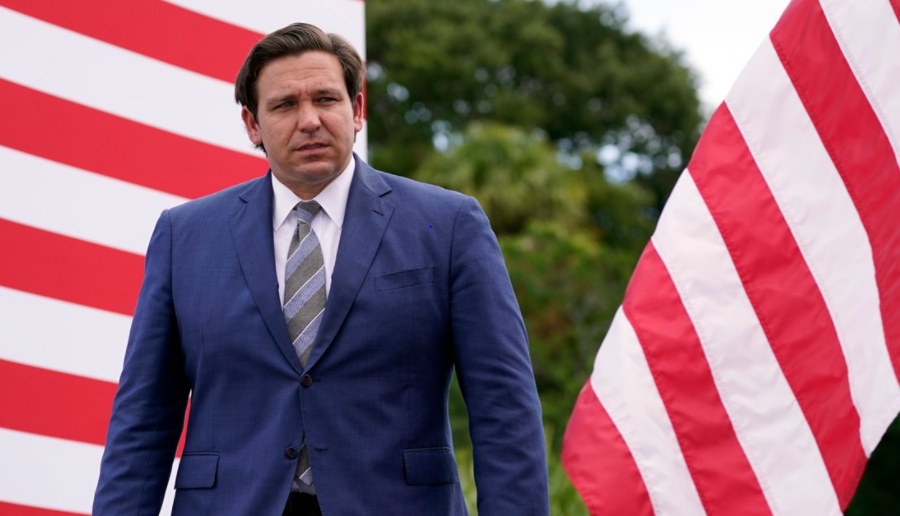
Conventional wisdom among Florida Republicans (and party loyalists across the nation) holds that Gov. Ron DeSantis will cruise to reelection on Nov. 8, 2022. Then with mission accomplished, he will ascend to the virtual 2024 presidential nomination podium a step below former President Trump, the GOP’s strongman and undisputed leader.

More conventional wisdom has Trump running again “provided he is in good health,” reportedly what he told associates back in May. If Trump bows out, DeSantis will be positioned to win the GOP’s “gold medal.”

But conventional wisdom 16 months before Election Day is often proven wrong. Even more so in a volatile swing state such as Florida, where anything can and does happen. Although it is unlikely that DeSantis will lose reelection, it is well within the realm of plausibility. Moreover, it is not hyperbole to state that there has never been a modern gubernatorial reelection with such far-reaching national consequences.

Therefore, let’s explore some variables, circumstances, election data, prevailing political winds, wild cards and unique “category five” Florida factors that could derail the current trajectory of this 42-year-old rising star often called “America’s governor” by Republicans across the land.

Mirroring Trump, DeSantis’s high national media profile among the GOP base was cultivated by frequent primetime appearances on Fox News’s most popular shows. Those appearances are also why a blinking neon target is glued to the governor’s back. Thus, when the need arose to chronicle and respond to attacks, a “DeSantis Derangement Syndrome”-named Twitter account was started and reported by Fox News.

DeSantis syndrome is expected and somewhat relished by the always-fighting governor, representing the future post-Trump Republican Party whenever Trump is dethroned, willingly steps down or passes away.

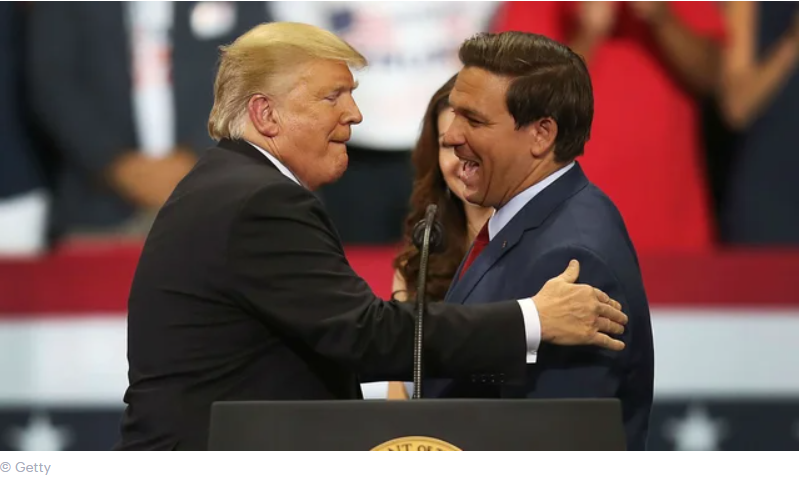
Well-established as a Trump acolyte in GOP circles, DeSantis is “Trump without the baggage.” With their futures linked together, Trump recently boasted that in 2018 when DeSantis “came out as a congressman” — running for governor while unknown statewide — “I was the first one to endorse him.”

Trump is also teasing DeSantis as a possible running mate, resulting in Trump-DeSantis 2024 merchandise delighting the MAGA base. DeSantis’s reelection, win or lose, would signal smooth sailing or rough seas for both men. Still, no credible political analyst believes DeSantis will join Trump’s 2024 ticket, even if he loses reelection.

Presidentially, and especially for the GOP, Florida is the must-win mother of all swing states, boasting 30 electoral votes after the 2020 census. As with all states, the governor’s party can help impact whether those votes land in the red or blue column. In 2020 Trump credited DeSantis with helping him win Florida, and losing the governor’s office could be devastating for 2024.

With so much at stake, Democrats are aching to defeat DeSantis. But who can do the deed? Currently, Rep. Charlie Crist, the former one-term Florida Republican governor, serving between 2007 and 2011, is emerging as the strongest in a field of weak Democratic primary candidates.

Crist is striking at the heart of DeSantis’s identity — COVID leadership. And given that DeSantis rose to fame as a COVID contrarian, the Delta variant could be his strongest opponent. This week, a spate of unfavorable national headlines, such as “Florida Leads U.S. in Covid-19 Cases as Hospitalizations Surge,” will test DeSantis’s 2020 reputation as the governor who “kept Florida open for business.”

But when early voting begins next fall, COVID might be contained. Then DeSantis could potentially win reelection with the messages merchandised at his campaign store: “Keep Florida Free” and “Don’t Fauci My Florida.” Most notable are can-coolers quoting the famous DeSant-ism: “How the hell am I going to be able to drink a beer with a mask on?”

COVID may fade, but DeSantis’s 2024 presidential aura grows stronger, providing fodder for Democrats. During a campaign rally last week, Crist said, “This current governor is running for president. He’s treating Florida like she’s a stepping stone.”

Echoing Crist is Thomas Kennedy, a Democratic National Committee member from Florida, who said DeSantis is “running for president, not for governor. He’s much more interested in fundraising and shallow and destructive appeals to the MAGA base.”

How DeSantis’s White House ambition and national reputation will impact his reelection prospects could be the issue to watch.

Despite constant downplaying, DeSantis acts like a presidential candidate. He traipses around the nation attending high-profile fundraising events with his PAC, which has raised $36.7 million thus far in 2021 ($17 million from out-of-state donors), a presidentially encouraging amount.

Appealing to his national base, DeSantis recently toured the Texas border after deploying Florida law enforcement members to help patrol. Always on Fox News, DeSantis walks a tightrope between 2022 and 2024. He could risk falling since he was barely elected in 2018, winning by only 0.4 percent — mandating a machine recount.

Here is why Florida is the definition of a purple toss-up state:

As of September 2020, Florida had 13.5 million registered voters. Democrats accounted for 36.8 percent, Republicans 35.2 percent, unaffiliated with 26.9 percent and minority party 1.1 percent. Hence, DeSantis’s reelection hinges on appealing to a wide swath of voters while he increasingly panders to his GOP base, signing court-contested voting restrictions and anti-riot laws.

DeSantis’s response to disasters, such as the recent Surfside condo collapse, hurricanes and tragic events that always seem to befall Florida, will either help or hurt him. All are wild cards, but Donald Trump is the most unpredictable. How much the former president will impact and participate in DeSantis’s reelection is unknown. And if Trump were to help the governor win big, DeSantis could still emerge more formidable.

My only prediction is that DeSantis will have a brutal campaign since outside the GOP, he is considered to be a polarizing Trump stand-in, yet feared by Democrats who must take him out before he becomes a 2024 contender.

The governor will have untold millions in campaign money, continuously appear in the media and be tested like a presidential candidate since Florida in 2022 is a 2024 Republican harbinger, putting Trumpism to another test.

Myra Adams writes about politics and religion for numerous publications. She is a RealClearPolitics contributor and served on the creative team of two GOP presidential campaigns in 2004 and 2008. Follow her on Twitter @MyraKAdams.


Credit: AP Photo/Steve Helbe

By Myra Adams – RCP Contributor

MYRA’S COMPLETE ARCHIVE IS HERE

Reposted from RealClearPolitics – June 30, 2021

Data from a recent poll and an economic report open a troubling window on  the perceptions and behaviors of the American people, particularly those under age 24. Although unrelated to each other, the poll and the report point to a downward spiral in economic attitudes that is well beyond the capacity of a president, government, or political party to fix.

Let’s begin with the economic report from The Center for Economic and Policy Research — a think tank that bills itself as promoting “democratic debate on the most important economic and social issues that affect people’s lives.”

CEPR’s findings were so harrowing that for two days, the Drudge Report linked to the study’s headline: “One in Five Young Adults Is Neither Working Nor Studying in U.S.”

The report focused on a “NEET rate,” meaning those “not in employment, education or training,” a category in which “3.8 million Americans age 20 to 24” languished during the first three months of 2021. Pandemic-related or not, this is an economically devastating statistic with countless adverse ripple effects.

Daily there are news reports about a worker shortage across most economic sectors, including many critical ones, and at the lower end of the pay scale with jobs that traditionally attract low-skilled younger workers. At this time, the bottom line is anyone who wants to work can find employment; the same holds true for schooling or training of various kinds.

Reporting about the CEPT study, Bloomberg/Quint wrote: “Inactive youth is a worrying sign for the future of the economy, as they don’t gain critical job skills to help realize their future earnings potential. Further, high NEET rates may foster environments that are fertile for social unrest.”

Ah, “social unrest” — an exciting opportunity to join a street mob, protest or support a cause with the potential for an awesome after-party.

What stands out from the recent Jan.-March 2021 NEET rates is the comparison to the same time period in 2020, before the pandemic shut down America. That 2020 baseline number indicates the “inactive youth” problem existed pre-pandemic but has accelerated.

Shown below is CEPT’s demographic breakdown of the 3.8 million idle 20-to-24-year-olds with each group’s percentage increase from 2020:

Asians: 14.3% — an increase of 3.9%
White: 15.9% — 3.1%
Hispanic: 19.7% — 3.5%
Black: 24.8% — 3.9%
Other: 31.7% — 11.2%

(Note that the percentages add up to 106.4. CEPR offers no explanation for this total.)

The CEPT study concludes: “The American Rescue Plan [passed in March] will help improve the employment and educational prospects for young adults. But current and ongoing recovery efforts need to do more to ensure that young adults in today’s diverse working class can improve their long-term prospects in the labor market and prosper in the years ahead.”

But is the idle-youth problem in our capitalist market economy more an issue of self-motivation than the government’s “need to do more to ensure” that they will prosper?

The answer — or some clues to it — might be connected to the findings of a recent poll by Axios/Momentive, which indicate a disturbing trend in favorable attitudes toward socialism at the expense of capitalism.

Overall, 57% of Americans expressed a positive view of capitalism, with 36% negative. The same poll in 2019 showed 61% positive with 36% negative. A four-percentage-point positivity decline is a worrisome signal for the health of American capitalism.

More alarming is the attitude about our free market system among those aged 18 to 24. Only 42% have a positive view of capitalism, with 54% expressing negativity.

Worse is that 51% of these young adults view socialism positively. The general public’s perception of socialism as positive registers at 41%, with only 52% holding negative views. The 10-point difference between young adults’ favorable view and that of Americans overall significantly impacts our national future — especially considering last week’s screaming headline “One in Five Young Adults Is Neither Working Nor Studying in U.S.” 

What are the future expectations of those 51% of young adults? Are they confusing the economic system that traditionally means “government controls the means of production” with social media? Do they expect the government to support them in the coming decades? And how many of the 3.8 million not in school or working are employed by the underground economy, or involved in illegal activity?

Also troubling is that among Black Americans, socialism is viewed positively by 60%. And remember that nearly 25% of the 3.8 million 20-to-24-year-olds not working or in school were African American. 

When trying to “Save America,” as our former president’s new slogan implores, how will the hot-button issue of wealth inequality ever be resolved when just over half of young adults don’t positively view the capitalistic system that made America great?  A market economy relies on individual responsibility, motivation, hard work, skills, dedication, ingenuity, risk, financing, technology creativity, etc.   

Yes, only the American people can save America, and the future looks bleak when half of young adults apparently look askance at those qualities. Perhaps our government should institute mandatory reeducation camps to teach the difference between the two systems. (With no smartphones, Netflix, Tic-Tok, or social media for 30 days!) Afterward, the skill-less of all ages would be rounded up and sent to another camp to learn a trade — all for the greater good of the motherland.  

I joke, but our nation can only remain a superpower when every citizen knows what is expected of him or her and understands that capitalism depends on the fundamental personal will to succeed — and to keep trying if at first you don’t.

That is why our nation has survived to celebrate its 245th birthday. And now, the next generation must learn that saving America means the government cannot save them.


Credit: AP

By Myra Adams – The Hill contributor

MYRA’S COMPLETE ARCHIVE IS HERE

Reposted from The Hill – June 23, 2021

Six months have passed since I declared myself “politically homeless” after 46 years as a loyal Republican, but still I am deluged with piles of GOP junk mail.

Recently catching my eye was a slick, oversized envelope from Florida Gov. Ron DeSantis with that distinct look of a fundraising appeal one would receive from a potential 2024 presidential candidate. In bold underline, the envelope screamed:

“The power-hungry Democrats, Big Tech Billionaires, and liberal media want to SILENCE conservatives like us. If you’ve seen me on TV, you know I’m fighting back and won’t back down! But I need your immediate help!”

Most intriguing was that the governor’s plea did not mention Florida or his 2022 reelection.

Coincidentally, moments before opening the mailer, I saw the Drudge Report headline “DeSantis Wins Straw Poll.” The poll had only 371 participants who were encouraged to vote multiple times among the 500 people who attended last weekend’s Western Conservative Summit in Denver. And they only voted for “approval,” of which DeSantis garnered 74 percent, edging out President Trump’s 71 percent.

The poll is junk, except for the fact that the outcome was widely reported — feeding the continuing narrative that Trump had better “watch out” for DeSantis in 2024. Undoubtedly, both men are on a collision course.

Given such high stakes, let’s “decode” what DeSantis wrote in the mailer. But honestly, no decoding is needed since the governor’s message is clear, bold, repeated several times, yet brilliantly subtle.  

DeSantis begins the four-page letter with a zinger title, “Future of GOP At Stake.” Is that a dog-whistle warning directed at the former president who, by all accounts, is still the undisputed leader of the Republican Party? Then DeSantis goes on offense with a positioning statement as his first sentence:  

“Dear Fellow Conservative, I’m writing you today because the direction of the Republican Party is totally up for grabs.”

How could the party’s “direction” be “totally up for grabs” when Trump and MAGA Trumpism is the GPS of the GOP and Trump rules with an iron fist? DeSantis knows repetition is an essential part of messaging, and why four short paragraphs later, he wrote:

“That’s why I’m personally asking you to help me set the right direction for our party and America over the next four years.”

The “help” DeSantis “asked for” was how the GOP “must not turn back to the old establishment apologists” (that means Mitt RomneyLiz Cheney and Paul Ryan). And why “we need to continue to pursue a conservative agenda like President Trump did and put hardworking American taxpayers first.”

Notice how DeSantis wrote in the past tense, “President Trump did,” instead of President Trump “does.”

The Florida governor, channeling Trump-like strength while positioning himself to be the national party leader, wrote, “I firmly believe Republican-led states like Florida must lead the way and help save America from the far-left socialist agenda that threatens our liberty and that of future generations.”

But “far-left socialists” were not among those who attacked national liberty and democracy in progress at the Capitol on Jan. 6. Therefore, let’s take a quick break from the governor’s leadership plan for a TV reality check that occurred on June 7 during Trump’s interview on Fox Business Network’s “Varney and Co.”  

Trump, who must always be on top, is the master of the political put down, especially when feeling threatened. And the former president’s blood pressure must spike when he hears the popular GOP catchphrase, “DeSantis is Trump without the baggage.”

Thus, Trump told host Stuart Varney, “I was at the beginning of Ron. I was the first one to endorse him when he came out as a congressman that a lot of people didn’t know. My endorsement helped him tremendously.”

That statement followed Trump asserting his dominance over DeSantis when first asked by Varney if he would consider DeSantis as his 2024 running mate. Trump answered: “Sure, I would. But there are numerous people who are great. I would certainly consider Ron.”

Reporting on the Varney-Trump interview was FloridaPolitics with the headline, “Did Trump create DeSantis? He certainly likes to take credit.”

A “yes” answer requires only 30 seconds of watching DeSantis’s most famous and embarrassing 2018 GOP gubernatorial primary commercial. The ad proves DeSantis — then virtually unknown in Florida — allowed himself to be created in Trump’s image.

One could argue that Trump did “create” DeSantis. However, there was reciprocity. In 2020 DeSantis helped deliver Florida to Trump by 371,686 votes, which he mentioned in the mailing, illustrating how the governor likes to placate Trump.

Moreover, DeSantis wrote that “Florida did one of the best jobs counting votes in the entire country. And you could never say that before the 2020 elections!” And he brags, “The ‘Trump Florida Firewall’ project I set up for the Republican Party of Florida was a huge success.”

That statement raises the question of why in May did DeSantis sign an election restriction bill currently being challenged with three federal lawsuits?

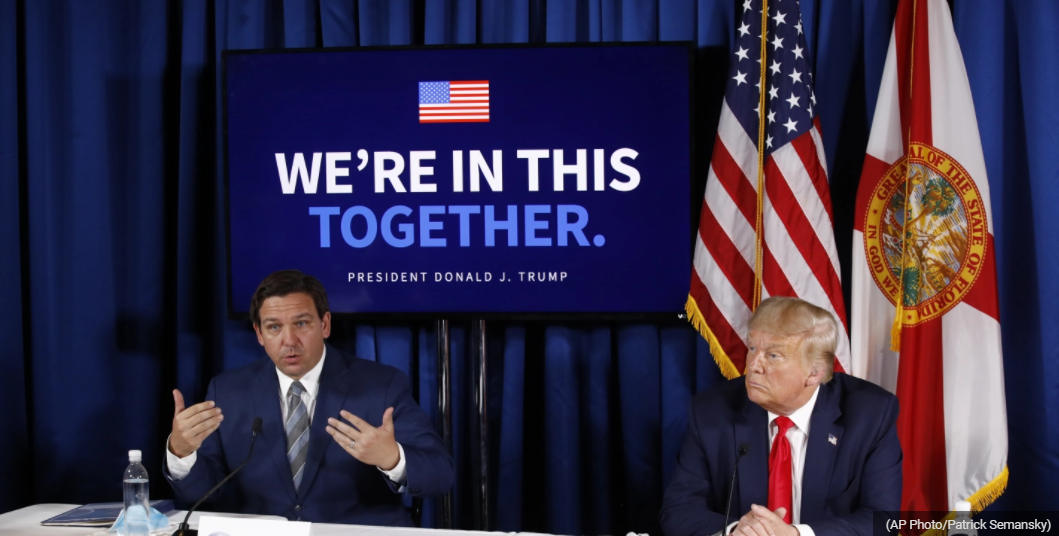
It is interesting that besides the photo of DeSantis on the envelope, the only inside photo is of Trump and the governor on the donate page. There, after three long pages of DeSantis touting his accomplishments from a national perspective and only once mentioning his reelection, does the reader learn that this is a fundraising letter for the Republican Party of Florida.

The mailer proves that DeSantis is a brilliant player, positioning himself as the GOP’s future while only lightly kissing the ring of his “creator.” Above all, DeSantis knows the creator must never lose or be overtly defeated because he will turn against the man he created.

Myra Adams writes about politics and religion for numerous publications. She is a RealClearPolitics contributor. She served on the creative team of two GOP presidential campaigns in 2004 and 2008. Follow her on Twitter @MyraKAdams.


MYRA’S COMPLETE ARCHIVE IS HERE

Reposted from RealClearPolitics – June 10, 2021

By Myra Adams – RCP Contributor

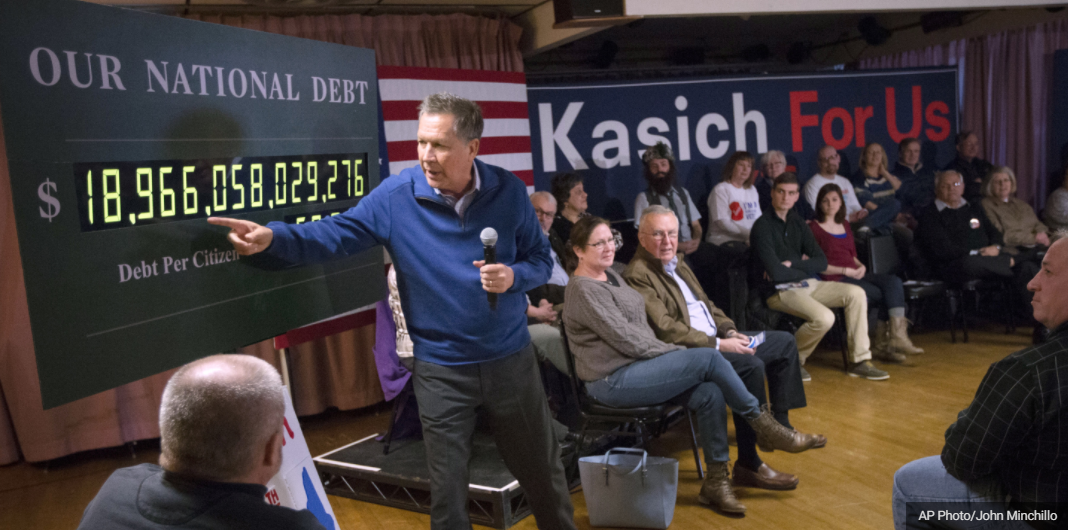
Remember the 2012 Republican National Convention? Back then, the national debt problem was so fundamental to the GOP’s platform that the convention’s set design showcased a debt clock ticking away in real-time, edging closer to $16 trillion.

Vice presidential nominee Paul Ryan, a conservative tax and budget expert, championed policies that slowed the debt’s alarming rate of acceleration toward what he deemed a dangerous fiscal cliff, which was not a priority for his opponent. When Barack Obama was elected in 2008, the debt was $10 trillion. After fighting the Great Recession, it nearly doubled to $19.5 trillion by the end of his second term.

But the next Republican president didn’t do much better. At the end of 2020, the debt was $26.9 trillion. Today, according to the U.S. Debt Clock, it is $28.3 trillion. 

Most problematic is how gross domestic product has failed to grow commensurate with the debt. There has been a school of thought that downplayed the growing red ink, instead touting the debt-to-GDP ratio as more relevant. A brief history of that ratio demonstrates why that “school” has closed.

In December 1969, when the government spent billions fighting the Vietnam War, the ratio was 35.47%.

Interestingly, the ratio dipped to 30.86%, the 1970s lowest level, during the month when Richard Nixon resigned as president, August 1974.

By the end of that decade, the number rose slightly to 31.03%.

The 1980s ended with it jumping to 51.38%

The 20th century closed with a debt-to-GDP figure of 58.35%. 

Then came the 9/11 attacks. As a result, the government’s price tag to fight the war on terror, including in Afghanistan and Iraq, caused a substantial increase in the ratio, which rose to 92.02% by the end of 2010.

In 2020 the COVID pandemic crashed the U.S. economy. By October, the government had spent $4 trillion in various economic bailouts, increasing the ratio to 129.09% by year’s end.

According to today’s Debt Clock, the number stands at 127.99%, a slight decrease from Dec. 31 but still precarious.

Is the government projecting that, when the economy surges back to “normal,” this unsustainable ratio will decrease?

Unfortunately, no, according to two U.S. government agencies.

The Congressional Budget Office, providing economic and budget data to lawmakers, projects that by 2025 the figure will be 124.56%. Even more daunting is the Office of Management and Budget projection. The agency within the executive branch foresees the 2025 ratio increasing to 138.69% — 10.7 percentage points higher than today! That is your government at work.

But more eye-popping is the non-governmental U.S. Debt Clock’s 2025 projections, based on current rates of growth. It shows the national debt hitting $50.1 trillion, the GDP at $26.7 trillion, and the debt-to-GDP ratio at a whopping 187.86%.

What ramifications do all these numbers have for the average American? The cost of living and anything you want to finance could cost more. In March 2021, the CBO issued a report titled “The 2021 Long-Term Budget Outlook,” which said:

“Debt that is high and rising as a percentage of GDP boosts federal and private borrowing costs, slows the growth of economic output, and increases interest payments abroad. A growing debt burden could increase the risk of a fiscal crisis and higher inflation as well as undermine confidence in the U.S. dollar, making it more costly to finance public and private activity in international markets.”

And what are the overarching reasons why the U.S government is spending itself into an ever-deepening fiscal crisis? The simple answer is our government is trying to maintain its status as the world’s superpower in a competitive 21st century global economy while modernizing infrastructure and providing for the needs of its people.

But, the hard truth is that our economy does not generate enough revenue to pay for what is required to do all three. For example, today the U.S. Debt Clock shows federal tax revenue at $3.4 trillion. That is a fraction of what the government owes just in unfunded liabilities of $149.2 trillion – payments promised to the American people.

Our nation can’t continue down this path forever because, at some point, there will be forced entitlement cuts and, worse, national instability.

National needs outpacing revenue also dramatically applies to infrastructure. President Biden proposed a $2 trillion infrastructure bill with much fanfare, widening the term’s traditional definition. And if the bill manages to pass, it will substantially increase the national debt. The need is there, but the funds are not. Everyone sees crumbling roads, bridges, and now the daunting task of fortifying cyber systems that operate critical infrastructure. The Colonial Pipeline hack showcased our national vulnerabilities — to the delight of our enemies.

Moreover, Biden’s new $6 trillion budget proposal looks like the Debt Clock’s projection of a $50 trillion national debt by 2025 could be on track.

But the most severe crisis facing our nation is denying the debt crisis. Instead, our weak-kneed leaders are afraid to level with the American people about the implications of rising debt while the government spends at rates that far exceed tax revenue and GDP. When was the last time you heard the president or leaders of either party speak out about this painful issue? Yet, any solution starts with recognizing the problem. The Republican Party used to lead on the debt problem and should again.

Therefore, I recommend that the GOP dust off its national debt clock from the 2012 convention and hang it above the floor of Congress. At least then, our national fiscal doomsday crisis will be impossible to deny as it stares leaders in the face.


MYRA’S COMPLETE ARCHIVE IS HERE

Reposted from MEDIUM on May 27, 2021

Every American knows the date of Donald Trump’s last rally in Washington, D.C. The political fallout continues with the aftermath seared into our collective memory when the president’s most ardent supporters marched from the rally and violently breached the Capitol.

In the seven days following the Jan. 6 “insurrection,” when shocking video was horrifying the nation, nobody could have predicted that the soon-to-be-former president — impeached for a second time in record time — would resume hosting his now-infamous rallies only six months later.

In America, anything is possible, and Trump proved that axiom last week. While appearing on the Trump-loving, One America News network, the former president announced his rally plans saying, “We’ll be doing one in Florida, we’re going to do one in Ohio, we’re going to do one in North Carolina,” with details released, “relatively soon.” However, Trump could be indicted, which may or may not alter his rally plans.

Aside from that minor detail, imagine how much bashing, trashing, venting, and bragging will spew from the former president’s mouth — a fact-checkers feast. But, before speculating about the rally’s theme, content and objectives, two overarching issues could become problematic for Trump and nullify any political benefits.

Security Costs

A potentially thorny issue about who will pay for what is sure to be supersized security. Of course, the Secret Service is responsible for Trump, and recently he was accused of profiting from the benefit of their protection.

But the intriguing question is whether taxpayers will foot the entire bill for all the post-Jan. 6 rallies. New ground will be broken since no former president has engaged in a sustained political come back tour on the scale that Trump is teasing.

I say “teasing” since recently, on his DonaldJTrump.com mouthpiece, he boasted about his “beautiful Boeing 757 that became so iconic during the Trump rallies.” The plane is currently being “updated” and “prior to the end of the year,” he says, “it will be better than ever, and again used at upcoming rallies!”

This year and into the 2022 midterm election campaign, his rally security costs could morph into a passionate political hot button. The negative press will emphasize that Trump is a billionaire, and his Save America PAC began the second quarter with $85 million in cash. Hence, the PAC and not taxpayers should shoulder a healthy percentage of the security costs at his highly partisan, self-serving political rallies.

Moreover, Trump uses these rallies as income generators. He collects attendee data for future fundraising solicitations while earning millions of dollars in free advertising through media coverage.

Along with increased costs incurred by the Secret Service, rallies impact the budget of local law enforcement. When Trump left office, it was reported that ten cities were owed “at least $850,000” in unpaid invoices. Recently, Albuquerque turned over a $211,000 debt to a collection agency stemming from Trump’s Sept. 2019 rally.

With that track record, will local jurisdictions demand upfront security payments before granting rally permits to the former president?

Super-Spreader Events 2.0

At the height of the pandemic in 2020, Trump rallies were widely thought to be super-spreader events — proven true by a Stanford University study. As national COVID rates are rapidly decreasing with half the population vaccinated, surveys show that Trump voters tend to have lower vaccination rates.

Therefore, Trump’s 2021 and 2022 rallies could again turn into super-spreaders (and now easier to trace back), resulting in the villainization of Trump and his supporters.

Conversely, Trump has an extraordinary opportunity to generate good news at his rallies by encouraging attendees to get vaccinated or, better yet, “make vaccinations great again” and available on site.

All the Political Considerations

As mentioned earlier, Trump’s post-Jan. 6 rallies will showcase his penchant for bashing, trashing, venting, boasting — and don’t forget his signature name-calling. But let’s highlight the former president’s number one objective for holding rallies: To remove “former” from his current title. Therefore, at every rally, expect him to flirt with the audience asking, “Should I run in 2024?” The answer will be cheers of “four more years” with Trump 2024 banners waving — repeatedly shown on Trump-friendly media outlets.

The former president aims to clear the 2024 field, canceling the need for a GOP primary. And, he might be successful since a mid-May Morning Consult poll found that 50 percent of GOP primary voters support Trump, with his former VP Mike Pence a distant second at 13 percent.

But mixed signals for Trump are seen in a new Quinnipiac University poll finding 66 percent of Republicans want him to run in 2024, but 66 percent of Americans do not.

Trump’s second rally objective is revenge upon any GOP officeholder who dared not support his “Big Lie” or voted for impeachment. You know their names, and Trump will call them out for booing. The flip side is his support for candidates who can defeat any officeholder not 1000% loyal to Trump, rewarding them with an on-stage appearance.

Theoretically, Trump rallies are to support the Republican Party’s attempts to win back the House and the Senate — convenient cover for his number one objective. Rallies solidify Trump’s standing as the supreme Republican leader, branding the party’s present and future in his name. Candidates and incumbents are either with Trump or against him. There is no middle ground.

Attending Trump rallies will be his adoring base — the 53 percent of Republicans who believe Trump remains the “true president” and the 61 percent who say the election was stolen — according to a new Ipsos/Reuters poll.

Embracing those beliefs is Trump’s main schtick while recanting all the reasons why attendees know he is the greatest president. But alas, he was cheated and victimized by mail-in voting, election officials, courts, the FBI, voting machines, high-tech, corrupt media, social media — but still managed to win more votes than any incumbent president. That list is what they came to hear with a potential indictment only another Trump victim card to be played.

The fact that Trump’s old stage act is reopening to the same loyal audience six months after the Jan. 6 rally is not just a feat of savvy showmanship but a miraculous political resurrection.


MYRA’S COMPLETE ARCHIVE IS HERE

Reposted from TOWNHALL – May 14, 2021

In news coverage, I repeatedly see or hear a word that used to be alien to Americans since, historically, it is associated with authoritarian governments and centralized economies. That word is “shortages.”

Currently, there are 17 COVID-related shortages in major and minor consumer products and medical supplies but expected to be resolved, albeit with price increases. Included are new cars, chlorine, lumber, pet food, homes, chicken, and hotdogs, to name a few. Most formidable is a fuel shortage — already in play due to the lack of gas truck drivers (see more on that below) — but exacerbated by the oil pipeline cyberattack, on the verge of becoming a national security threat. Now, after paying ransom, the pipeline is slowly reopening, but supply vulnerabilities remain. 

Aside from short-term commodity shortages, long-term non-COVID-related human resource shortfalls have plagued five major occupations for over a decade. Think of these career fields as steel beams supporting the societal infrastructure of a thriving market economy. Moreover, the cause and effect of such chronic workforce shortages are harbingers of an existential national crisis that will take herculean efforts to resolve. But if not resolved, national decline is inevitable. Let’s briefly examine the occupations. 

Teachers

The K-12 teaching profession has been impacted by rapid cultural, societal, economic, and demographic changes, resulting in an ongoing teacher shortage severely accelerated by the pandemic. 

Recently, Frontline Research and Learning Institute conducted a national survey of 1,200 school and district leaders concerning all aspects of the severe shortage. Unfortunately, their findings “paint a grim picture,” and “only 7%” of the leaders believe the teacher shortage will improve.

The top three reasons cited are a shortage of fully qualified applicants, low compensation and benefits compared to other careers, and fewer education school graduates.

However, I know a few teachers who say the following reasons make their jobs a daily struggle and contribute to retention problems among new teachers: Parental interference, administrators’ demands, constraints on classroom discipline, and mixing students in the same classroom with the widest range of abilities, including special needs, and non-English speakers.

Then the overarching, often unstated reason for the shortage — a bittersweet by-product of the women’s movement when teaching used to be the go-to profession for female college graduates. Today women have unlimited career opportunities offering higher compensation. 

Will higher salaries solve the problem? Somewhat. But the joy and status of teaching are diminishing. One recently retired teacher told me her job became increasingly challenging because “every year the kids had shorter attention spans.” 

An effective public education system is the hallmark of a robust national economy, the great equalizer that lifts and launches all its young citizens. Teachers are the backbone, but that spine will crack unless radical changes are instituted to attract and retain new ones. 

Truckers

The trucking industry is the life-blood of our national economy, moving 71% of all freight. Truckers’ vital role becomes apparent whenever severe weather interrupts grocery store deliveries. The current driver shortage is a growing crisis expected to worsen due to the projected number of retirements.

The shortage explains why I always hear trucking companies advertising for drivers on my car radio. According to a Fox Business report, “The American Trucking Association expects the need to hire roughly 1.1 million new drivers over the [next] 10 years or an average of 110,000 per year.”

This is not an easy line of work considering the training, skill, and time away from home, but decent pay and benefits offer a secure middle-class family income.

With the U.S. economy so dependent on truckers, a continuous shortage of drivers with fewer trucks on the road means their higher wages are ultimately passed along to consumers. The inflationary ripple effect is mindboggling, especially when higher gas prices figure into the equation.

Police

There are daily headlines about police retirements prompted by deadly incidents and defunding demands. But then at the other end is the challenge of attracting new officers. Nonetheless, recruitment, retention, and retirement were widespread, pervasive problems before the current round of deadly high-profile police incidents. Dive into this 2019 “Workforce Crisis” report from the Police Executive Research Forum and imagine how the crisis has accelerated. 

In April, Jack Rinchich, president of the 4,000-member National Association of Chiefs of Police, described the demoralized state of mind among his rank and file, saying, “‘Hey, I’ve gone 20, 30 years without being sued, shot, or divorced. I’m going to get out while I have an opportunity.’”  

The “thin blue line” keeping our nation from descending into chaos is projected to grow thinner. Therefore, out-of-the-box thinking is needed to attract new police applicants, along with a societal attitude adjustment returning policing to a respected and rewarding profession. Alternatively, (and worst-case scenario) if shrinking forces reach critical lows, expect the National Guard to be called up regularly — never a good sign in a benevolent, democratic nation.

Doctors

The pandemic showcased their role, and respect for the profession grew. Meanwhile, the projected shortage is in such critical condition that a Senate bill named the Resident Physician Shortage Reduction Act of 2021 was introduced in March to help alleviate the problem. According to AAMC (Association of American Medical Colleges), the “bipartisan bill aims to expand the number of federally-supported medical residency positions by 2,000 annually for seven years, directly addressing the growing physician shortage.” 

The need speaks to AAMC data projecting a “physician shortage of between 54,100 and 139,000 doctors by 2033.” Age is also a problem, “more than two of five currently active physicians will be 65 or older within the next decade.”

Earning an MD title is a long, hard slog that takes exceptional brainpower, dedication, and emotional strength. But our nation is only strong when its people are healthy and productive. Thus, doctors are critical human infrastructure that needs replacing.  

Nurses

This profession also played a starring role in COVID when much of the minute-to-minute work was in their purview. Meanwhile, the American Nurses Association projects a shortage of half a million registered nurses by 2026. Then, according to NursingWorld.org, “By 2022, there will be far more registered nurse jobs available than any other profession, at more than 100,000 per year. With more than 500,000 seasoned RNs anticipated to retire by 2022, the U.S. Bureau of Labor Statistics projects the need for 1.1 million new RNs.”

Besides retirement, the nursing shortage reflects the increased needs of an aging population. Add to that a shortage of nursing schools and faculty along with burnout on display during the height of the pandemic. The reality is that nursing is hard work, involves long hours, and requires a special person to enter and stay in the field.

Conclusion

Generally speaking, these five professions are suffering shortages due to the same problem, baby boomers are retiring with not enough replacements. All are traditional careers found less attractive by younger workers who can often make a good living with an internet connection from anywhere. These old careers require someone to leave home, go to a classroom, walk the street, hit the road, or enter a medical facility. 

However, the needs of these professions are not diminishing but increasing. We often hear about workforce shortages, but these five point to a crisis requiring a new national focus emphasizing the old-fashioned concept of community service.   


MYRA’S COMPLETE ARCHIVE IS HERE

Reposted from The Hill on May 6, 2021

Could an African American congresswoman from Orlando, Florida, change the course of presidential history? Maybe.

There is a lengthy list of high-profile and contentious races in 2022. But none compares to the national impact, intensity, influence and media coverage that Florida’s gubernatorial election will generate.

Let’s set the stage.

Gov. Ron DeSantis, one of the nation’s most recognized political leaders, is running for reelection on a solid record of accomplishment. His reelection would be merely a pit stop on the road to his likely 2024 presidential bid. And, mirroring his uncomfortably close but successful 2018 “Fox News campaign,” DeSantis is again practically on the payroll of the popular cable network. 

Ridiculing his frequent appearances, the Orlando Sentinel editorial board chided the governor in an April 29 editorial, calling him the “mayor of Fox News” and “Fox’s golden child.” The board explained, “He’s been a guest on the network’s talk shows nearly a dozen times during the [legislative] session, one of more than 40 appearances during the past year, at least half of those coming in the first four months of this year.” They also called DeSantis the “P.T. Barnum of policy.”

The paper’s criticism is poignant since DeSantis’s most formidable opponent could be Orlando’s three-term Rep. Val Demings (D-Fla.). With her “it factor” aura, Demings is busy raising her national media profile before her expected official announcement. The former Orlando police chief turned congresswoman was on Joe Biden’s VP shortlist after rising to prominence in early 2020 as a House manager during Donald Trump’s first Senate impeachment trial. Demings teased her gubernatorial intentions on Tuesday, tweeting, “Ready for the moment,” a video touting her rise from poverty.

But before Demings’s “moment” as the first woman and African American governor of the third most populous state, she must prove herself worthy by winning a crowded and competitive primary. After that, she must topple the popular DeSantis – widely considered the heir to Donald Trump and Republicans’ best hope to recapture the White House — assuming Trump does not run. 

If Demings is victorious, the mainstream media will crown her a trifecta rock star — politically slaying the Trump acolyte, crushing MAGA dreams and changing the 2024 GOP presidential nomination contest trajectory. More on that below, but first, some facts and history that make Demings’s dreams both plausible and a long shot. 

Demings’s two major primary opponents are also “ready for their moments,” and one is a double repeat. On May 4, Rep. Charlie Crist (D-Fla.), the Sunshine State’s Republican governor from 2007 to 2011, formally announced his second gubernatorial bid as a Democrat. His first was in 2014, when he was defeated by incumbent Republican Rick Scott, who in 2018 was elected to the U.S. Senate.

Yet, the buzz for Crist is lackluster. He is a rich white guy, nearly age 65 and likely past his prime for statewide office.

The other primary opponent is Nikki Fried, a 43-year-old white woman who, as agriculture commissioner, is Florida’s highest-ranking elected Democrat. Fried has continuously knocked heads with DeSantis, and her press release about Florida’s recently concluded 2021 legislative session accused DeSantis of running an “authoritarian regime.” But Fried has not yet caught fire, and Republicans consider her to be DeSantis’s weakest potential opponent.

Therefore, Demings’s imminent candidacy excites Democratic leaders since the party last won the governor’s mansion in 1994, when incumbent Gov. Lawton Chiles narrowly defeated Republican Jeb Bush.

Demings’s chances could also be boosted by the outcome of the 2018 Democratic gubernatorial primary with its crowded field of seven candidates. The two most prominent names were Gwen Graham and Philip Levine. They came in second and third, splitting the white vote. That allowed little-known Andrew Gillum, the African American mayor of Tallahassee, to win in an upset with only 34 percent of the vote, compared to Graham’s 31 percent and Levine’s 20 percent. 

On the other side, DeSantis in 2018, then a congressman representing the Daytona area, was also a statewide unknown. Yet, due to his continuous presence on Fox News and flaunting unabashed love for President Trump, he eked out the smallest margin of victory – 49.59 percent to Gillum’s 49.19 percent – a difference of 32,463 votes out of more than 8 million cast. 

2018 feels like ancient history, given that DeSantis has risen to national prominence as a strong leader and fighter in the Trump mold. The overwhelming majority of Florida GOP voters are thrilled to support DeSantis’s reelection and proud to be his home base if he wins the 2024 GOP nomination — and perhaps Florida’s first native-born president, especially if a certain New York-born Palm Beach resident bows out of the race. 

We can expect Democratic candidates and non-Republican voters to argue that if reelected, DeSantis would quickly abandon his office, using his victory as a presidential platform to campaign and fundraise across the fruited plain. Hence, DeSantis’s toughest 2022 opponent is his own ambition.

Furthermore, Florida’s explosive growth could either help or hurt DeSantis, with the population surging from 20.8 million in 2018 to a projected 22.2 million by 2022. And as is often the case, new residents tend to bring their voting habits with them. Over the last year, due to a COVID exodus, 15 percent were from New York, 28 percent from Texas and 6 percent from California — a mixed political bag.

Suppose DeSantis and Demings were to faceoff in a general election. In that case, her race and gender would play a prominent role since Democrats tend to view politics through the lens of identity. That might give Demings an edge in what will be a nasty and close super-bowl-like election. Naturally, Trump will be a wild card, but it’s unlikely that DeSantis campaigns as a Trump acolyte. Still, Democrats will try to hang the former president around his neck. 

Finally, a DeSantis vs. Demings race could foreshadow how DeSantis might fare in 2024 or even in 2028 against another powerful woman of color currently one heartbeat away from the presidency.

No matter who wins, Florida’s gubernatorial election will impact America’s political stage.

Myra Adams writes about politics and religion for numerous publications. She is a RealClearPolitics contributor. She served on the creative team of two GOP presidential campaigns in 2004 and 2008. Follow her on Twitter @MyraKAdams.